Download
1 / 9
90 likes | 202 Vues
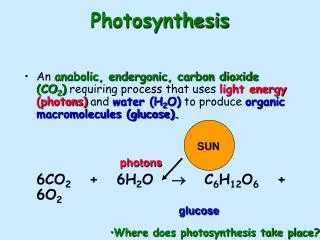
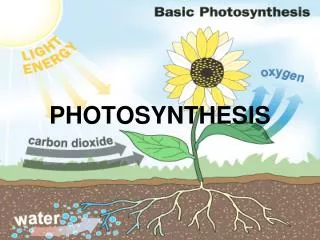
This resource outlines the photosynthesis process, highlighting the role of light energy in sustaining life. It explains how plants utilize photosynthetic pigments within chloroplasts to capture photons, initiating the light-dependent reactions in thylakoids. The conversion of light energy into ATP and NADPH is central to this process. The Calvin Cycle, located in the stroma, uses CO2 and H2O to synthesize glucose independently from light. The significance of glucose for all life forms, including humans, is also discussed, emphasizing the vital connection between photosynthesis and cellular respiration.

E N D
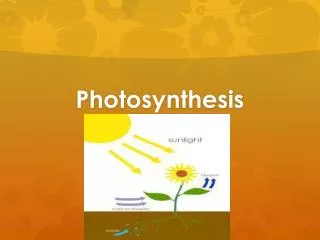
Photosynthesis Incorporation of light energy, and explanation of the chemical processes of By: Nick James Elli Nassivera Ryan Liss and kevin
Introduction • Both matter and energy are essential in sustaining life • While humans and other animals use cellular respiration to breakdown molecules and use energy, plants use photosynthesis • Photosynthesis uses light as its activation energy
Light as Activation Energy • Light is not matter • Light is the vibration of photons in the form of electromagnetic waves • Travel in different magni- tudes that the human mind defines as colors • Photosynthetic pigments within plants absorb photons of different magni- tudes • Pigments are found on exterior of thylakoids
Thylakoids Hosts first step of photosynthesis and the only light-dependent step Found in groups called granum Use energy of photons to power electron transport chains Forms ATP when protons travel through synthase Uses ATP and NADPH Lumen
Calvin’s Cycle • Where glucose is created, and NADPH and ATP are reduced • Light-independent • Reactants are CO2, H20, and activation energy from carriers • Located in the stroma of the chloroplast • Is very similar to Kreb’s Cycle of the mitochondria Video: http://www.youtube.com/watch?v=E_XQR800AgM
Conclusion • Glucose is essential for success of life on earth • Present in various forms and seen within different mechanical operations found anywhere • Humans also require glucose because of what we consume • Photosynthesis is required to naturally form glucose
Answer Key 1) Photosynthesis 1.5) chloroplast 2) plant 3) sustain 4) life 2nd 3) Photosynthesis 2nd 4) Reactants 5) H20 6) Glucose 7)Carbon 8) NADPH 9) ATP 10)Calvin’s Cycle 11)Independent 12) light 13) photons 14) Energy 15) photon 16) Energy 17) photons 18) electromagnetic 2nd 14) photons 20) protons 21) transports 22) Stroma 23) Equilibrium 24)Phospholipid-bilayer 25) ATP Synthases 26)ATP
Answer Key Cont. Multiple Choice: • C • A • B • C • B