Understanding Possessive Adjectives in German: Nominative and Accusative Cases
This guide provides a comprehensive overview of possessive adjectives in the German language, focusing on their usage in both nominative and accusative cases. Learn how to form and apply possessive adjectives for all grammatical genders including masculine, feminine, neuter, and plural forms. Through practical examples, discover how to express ownership related to yourself, others, and their belongings in various contexts. Enhance your German language skills with this essential resource for learners at all levels.


Understanding Possessive Adjectives in German: Nominative and Accusative Cases
E N D
Presentation Transcript
Possessive Adjectives By Natosha Ramstad pd 7
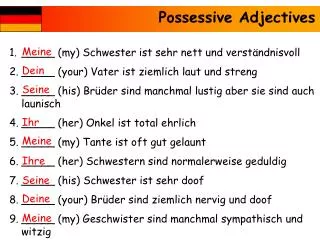
Nominative Masculine Feminine Neuter Plural ichmein(my) meinemeinmeine du dein(your) deinedeindeine ersein(his) seine sein seine sieihr(her) ihreihrihre essein(her) seine sein seine wirunser(our) uns(e)re unser uns(e)re ihreuer(your) eu(e)re euer eu(e)re sieihr(their) ihreihrihre SieIhr(your) IhreIhrIhre
Accusative Masculine Feminine Neuter Plural ichmeinenmeinemeinmeine du deinendeinedeindeine erseinen seine seinseine sieihrenihreihrihre esseinen seine seinseine wiruns(e)renuns(e)re unseruns(e)re ihreu(e)reneu(e)re euereu(e)re sieihrenihreihrihre SieIhrenIhreIhrIhre
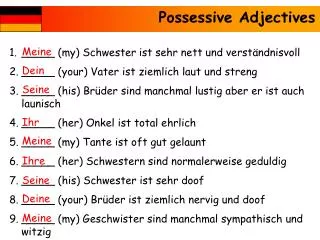
Examples • MeineFreundinheiβt Angelika. (Nom. Fem.) • Woistunser Fuβball? (Pred. Nom. Masc.) • Kennst du seinenBruder? (Acc. Masc.) • IchkaufeihrBuch. (Acc. Neut.) • WirbesuchenunserenOnkel. (Acc. Masc.) • IchbrauchemeineKamera. (Acc. Fem.) • HabtihreuerBuch. (Acc. Neut.) • Christine kannihreKameramitbringen. (Acc. Fem.)