Understanding Simple Machines: Types, Functions, and Applications
220 likes | 360 Vues
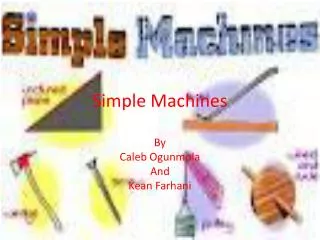
Explore the fascinating world of simple machines, including inclined planes, wedges, levers, wheels, axles, and pulleys. Learn how these machines multiply force, change direction, and make work easier. Discover the mechanical advantage (MA) of each machine, and see how they apply to real-life examples like ramps, knives, and vehicles. Understand the role of simple machines in the human body, such as bones and muscles acting as levers. Additionally, gain insight into compound machines formed from multiple simple machines and how their efficiencies are calculated.


Understanding Simple Machines: Types, Functions, and Applications
E N D
Presentation Transcript
Simple Machines Guided Reading and Study
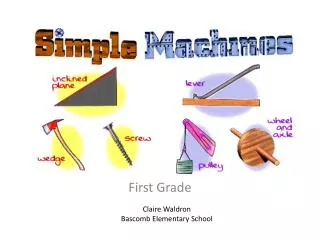
Inclined Plane • 2. Flat, sloped surface • 3. IMA: length / height • 4. The following are true: • a) Input force less than output force • b) A ramp is an example • d) Allows you to exert a force over a longer distance • 5. The larger (longer) the incline (less steep) the less input forceis needed to move an object
Wedge • 6. Thick at one end and tapers to a thin edge at the other end • Changes direction of the force • Examples: axe, zipper, knife, teeth… • 7. True – A wedge is an inclined plane (or 2 back to back) that can move • 8. True – longer, thinner wedges have a higher MA
Screw • 9. An inclined plane wrapped around a cylinder (Examples: screw, bottle cap (lid), curving parking ramp) • Multiples force (you input less force over a larger distance), can also change the direction of force • 10. The spiral inclined plane forms the threadsof a screw • 11. The input force is applied to the top of the screw. As the screw turns the threads exert on output force on the wood.
Lever • 12. A rigid bar that pivots or rotates around a fixed point. • 13. The fixed point that a lever pivots around is called the fulcrum
Lever 14. The following are true • a) A lever increases the effect of your input force • b) There are 3 different types of levers • c) A lever changes the direction of your input force
Lever • 15. • Fulcrum
Lever • 16. 2nd Class 1st Class 3rd Class
Lever • How levers make work easier depends on which class lever is being used. • 1st class: changes direction, can multiply force or distance • 2nd class: multiplies force • 3rd class: multiplies distance
First Class Lever Input force Output force Fulcrum
Second Class Lever Input force Output force Fulcrum
Third Class Lever Output force Input force Fulcrum
Lever • 17. • IMA: distance from effort (IF) to fulcrum distance from load (OF) to fulcrum
Wheel and Axle • 18. 2 circular objects fastened together that rotate around a common axis. The circle with the larger radius is the wheel • If input is turning the wheel: multiplies force • If input is turning the axle: multiplies distance • Examples: Steering wheel, screw driver, door knob
Wheel and Axle • 19. IMA = radius of wheel radius axle
Pulley • 20. Made of a grooved wheel with a rope or cable wrapped around it. • IMA: number of segments of rope that support the load • Examples are found on: flag poles, sail boats, construction cranes • 21. Type that changes the direction of input force = fixed pulley • 22. IMA of 2: moveable pulley • There are also block and tackle pulleys
Simple Machines in the Body • 23. Most of the levers in the body consist of bones and muscles • 24. Your muscles are attached to your bones by tough connective tissue called tendons • 25. In a living lever in your body the joint near where the tendon is attached to the boneacts as the lever’s fulcrum
Simple Machines in the Body 3rd Class Lever! • 26. Output Force Input Force Fulcrum
Simple Machines in the Body • 27. Incisors are wedges • 28. When you bite down on something, the wedge shape of your teeth produces enough force to break what you’re biting in half, just as an ax is used to split a log.
Compound Machines • 29. A machine that is made up of two or more simple machines. • 30. You must know the mechanical advantage of each simple machine utilized in the compound machine. The IMA of a compound machine is the product of the IMAs of the simple machines making up the compound machine.