Download
1 / 3
30 likes | 140 Vues
This document outlines the expected size and scope of the GLAST Guest Investigator (GI) Program and potential support from the Department of Energy (DOE) for cycles 2-5. It anticipates around 100 funded proposals yearly covering a wide range of scientific topics, including active galactic nuclei, supernova remnants, and dark matter searches. The budget support is structured across various investigation types, with minimum funding starting at $50k, predicting approximately $8M annually. Additionally, the program may attract 100-200 more users supported by other agencies and countries.

E N D
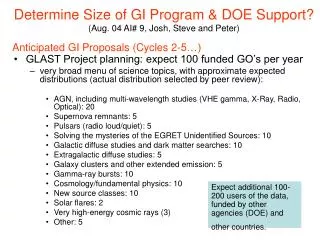
Determine Size of GI Program & DOE Support?(Aug. 04 AI# 9, Josh, Steve and Peter) Anticipated GI Proposals (Cycles 2-5…) • GLAST Project planning: expect 100 funded GO’s per year • very broad menu of science topics, with approximate expected distributions (actual distribution selected by peer review): • AGN, including multi-wavelength studies (VHE gamma, X-Ray, Radio, Optical): 20 • Supernova remnants: 5 • Pulsars (radio loud/quiet): 5 • Solving the mysteries of the EGRET Unidentified Sources: 10 • Galactic diffuse studies and dark matter searches: 10 • Extragalactic diffuse studies: 5 • Galaxy clusters and other extended emission: 5 • Gamma-ray bursts: 10 • Cosmology/fundamental physics: 10 • New source classes: 10 • Solar flares: 2 • Very high-energy cosmic rays (3) • Other: 5 Expect additional 100-200 users of the data, funded by other agencies (DOE) and other countries.
Budgets • With $50k minimum award, $80k average => $8M/yr in cycles 2 -> N • A GI program constructed as follows would likely meet anticipated proposals: • 70 investigations @ $80K/yr for 1-3 targets or limited survey objectives • 5 investigations @ $100K/yr for 3-10 targets or medium survey objectives • 3 investigations @ $250K/yr for 10-30 targets or major surveys and Legacy Proposals • 10 theory or analysis methods investigations @ $80K/yr • 5 supporting observation/monitoring investigations (e.g. radio) @ $80K/yr • Given present DOE policy for supporting only experiment teams as well as DOE budget pressures, it is unlikely that the GLAST GI program will receive significant support from DOE for GIs not already on DOE grants.
Cycle 1 NASA GI Program; DOE & Foreign • FY07 budget includes support at about half the level in subsequent years; support for analyzing released high-level data, learning tools & developing analysis, and correlated observations. • Expect ~50 Cycle 1 investigations. Likely emphasis on support of optical, radio monitoring and analysis of initial Catalog data release