Download
1 / 61
610 likes | 743 Vues
Dive into the fascinating world of light and its properties. Explore key concepts such as absorption, reflection, and refraction. Discover the rainbow of colors in the visible spectrum, from red to violet, and learn the differences between primary colors of light and pigments. We'll also uncover scientific techniques like chromatography and the role of optical components like prisms and filters. Gain insights into phenomena like mirages and the mechanics behind why objects appear their respective colors. Perfect for students and science enthusiasts alike!

E N D
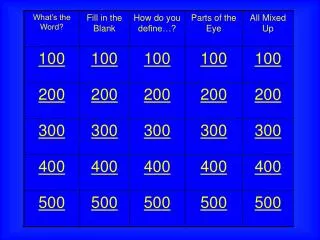
DAILY DOUBLE A range of wavelengths in the electromagnetic spectrum that we can see. (Name what you can see)
DAILY DOUBLE What is the visible spectrum of light (red, orange, yellow, green, blue, indigo, violet)?
A technique that scientists use to separate substances to study them.
The highest point in a wavelength is called the____________.
A ____________ is a substance that allows only certain colors of light to pass through it.
If there is _______________, it is caused by the bending of light as it moves from one material to another.
DAILY DOUBLE The lowest part of a wavelength is referred to as a ___________.
DAILY DOUBLE What is a trough?
A solid, transparent object that refracts light passing through- separating the light into the colors of the visible spectrum is called a ___________.
DAILY DOUBLE When light bends as it passes through air at different temperatures, we can see one of these.
DAILY DOUBLE What is a mirage?
Light from a light bulb, flashlight, or the sun is referred to as this.
DAILY DOUBLE Name at least three surfaces that reflect light.
DAILY DOUBLE Will accept any of the following: water, glass, metal.
DAILY DOUBLE Explain why when light shines on an apple, we see that it is red and no other color.
DAILY DOUBLE We see red because the apple reflects only wavelengths of red light and absorbs all other colors.
Other than visible light, name one other type of ray in the electromagnetic spectrum.
What is: X-rays, gamma rays, infrared rays, radio waves, microwaves.