Rainbows and Color
60 likes | 269 Vues
In this exciting lesson, students will delve into the science of rainbows and colors. They will learn how rainbows appear in the sky and discover that white light is made up of six distinct colors. Through engaging hands-on activities, students will create their own color wheels by mixing primary colors and observing the resulting shades. They’ll also experiment with CDs and rainbow glasses to see light in a whole new way. By the end of the session, students will understand color composition and how to create various hues, including how to make black. ###


Rainbows and Color
E N D
Presentation Transcript
Rainbows and Color Fall 2012
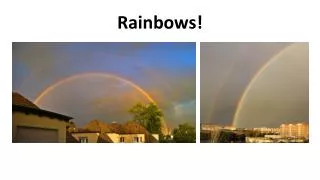
Introducing Rainbows • Ask students: • How many of you have seen a rainbow? • What about rainbows in places other than the sky? • Show students the “rainbow” on their handout. • Stress the order of the colors in the rainbow and how they always appear that way • White light is composed of these six colors, and these give color to everything
Rainbow glasses and cds • Pass out CDs and rainbow glasses to each student
Color wheel demonstration • Demonstrate how the combination of the different colors makes white light
Making a color wheel • Tell students that they are going to make their own color wheel by mixing the primary colors in exact proportions • Have students place the red drops first, followed by the blue, and lastly by the yellow. Stir the colors together with a toothpick (or finger). • Ask students to name what colors they have made • They can keep their colors by laying a paper towel on the sheet and blotting the liquid • They can repeat the experiment and “draw” all the colors into the center of the wheel and see that the end result is a dark brown/black color.
Mixing colors in a palette (optional) • Students can now make their own color combinations in the palettes • Tell students that they can use the color wheel information as a guide to different shades of colors • Ask students how they can make black