Economic Insights: Winter Births and GDP Trends
260 likes | 391 Vues
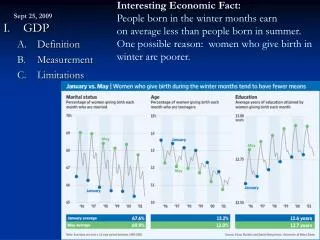
Research shows that individuals born in winter months earn, on average, less than those born in summer, possibly due to socioeconomic factors affecting women who give birth during winter. This interesting correlation opens up discussions about the impact of birth timing on economic outcomes. Additionally, exploring GDP—its definition, measurement, and limitations—reveals trends in economic growth over recent decades. Understanding GDP components and what it fails to capture, such as non-priced services and inequality, is crucial for grasping a country's economic health.


Economic Insights: Winter Births and GDP Trends
E N D
Presentation Transcript
Interesting Economic Fact: People born in the winter months earn on average less than people born in summer. One possible reason: women who give birth in winter are poorer. Sept 25, 2009 • GDP • Definition • Measurement • Limitations
GDP Gross Domestic Product: The market value of all final goods and services produced within a country in a year.
GDP Growth in your lifetime GDP in 1990 = $5,800 billion GDP in 2008 = $14,441 billion Growth = (14441-5800)/5800 = 148%
Adjust for inflation We want 1990 quantities at 2008 prices GDP in 1990 at 2008 prices = Real 1990 output x 2008 price of each good produced = $8,034 billion So real GDP growth is (14,441-8,034)/8,034 = 79.8%
What GDP Does Not Measure Non-Priced Services Illegal Activity Leisure Bads Poverty and inequality Love, Satisfaction, Happiness
A Tale of Two Koreas Note that in 1955 the two Koreas had approximately equal GDP per capita and they were both lower than Argentina’s. Today Argentina’s GDP per capita is $14,200
Access to Goods: Growth and Poverty Source: U.S. Census Bureau