Understanding Electromagnetic Induction: Generators and EMF
Explore how moving conductors, magnetic forces, and EMF creation work in generators. Learn about induced EMF, falling bar scenarios, alternating current generation, and DC generators.

Understanding Electromagnetic Induction: Generators and EMF
E N D
Presentation Transcript
A moving conductor causes electrons to move. Magnetic force applied to electrons The electrons drift to one end. Create an electric field Matching EMF At equilibrium forces balance. EMF from Motion
A bar 1.0 m long is dropped in an east-west orientation. The earth’s field is 2.0 x 10⁻⁵ T. Find the induced EMF after the bar falls for 4.0 s. The problem gives the length and the field, but the velocity is needed. Use basic kinematics v = v0 + gt v = (9.81 m/s2)(4.0 s) v = 39 m/s. Now use the equation for induced EMF. E= vBL E = 0.78 mV Falling Bar
As the sliding bar moves the circuit increases in size. The area increases by a rate equal to DA/Dt = vL. The number of field lines cut per second is the area change times the field. vLB in a uniform field The EMF equals the number of field lines cut per second. Cutting Lines
The sliding bar creates an EMF Potential difference in volts The potential can create a current in a resistor. There is power output from the moving bar. Power Bar
Alternating Generator • A turning loop of wire in a magnetic field generates EMF. • Loop area changes with respect to field lines
The moving loop alternates creating current one way then the other. Sinusoidal pattern Loop turns at rate w=q/t EMF based on loop area Extra turns increase the EMF This is called alternating current or AC. AC Generation
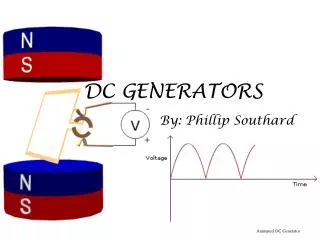
A DC generator can be made by using a commutator and brushes. Like a motor Voltage pulses but doesn’t reverse Better DC generators use multiple commutators. DC Generator next