Comprehensive Management Strategies for Neuropathic Foot Ulcers
280 likes | 396 Vues
Daily foot examinations are crucial in the prevention of neuropathic ulcers. Key signs to check include blisters, bleeding, injuries, and abnormal smells. Effective management includes general and specific measures such as maintaining good glycemic control and treating infections. Addressing neuropathic edema with diuretics and ACE inhibitors is essential, as it can impede healing. Over 90% of neuropathic ulcers respond well to conservative treatment methods, primarily achieved through pressure relief. Preventive measures such as regular foot inspections and patient education are vital to reducing ulcer incidences.


Comprehensive Management Strategies for Neuropathic Foot Ulcers
E N D
Presentation Transcript
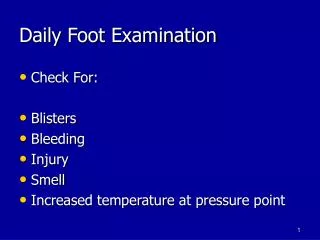
Daily Foot Examination • Check For: • Blisters • Bleeding • Injury • Smell • Increased temperature at pressure point
Management of Neuropathic Ulcer - 1 • General measures • Specific measures
Management of Neuropathic Ulcer - 2 • Good glycemic control • Treatment of infections • Management of neuropathic oedema
Management of Neuropathic Ulcer - 3 • All ulcers irrespective of their cause will be slow to heal in presence of oedema, due impairment of local flow • Neuropathic oedema can be treated with • Diuretics • Ace inhibitors • Ephedrine ( 30 mg tds ) • D/d: hypoalbuminemia cardiac failure
Management of Neuropathic Ulcer - 4 • “Over 90% of predominantly neuropathic • ulcers will heal satisfactorily with • conservative measures”
Management of Neuropathic Ulcer - 5 • “Key to the management is the relief of • pressure that caused the initial lesion” • Pressure is off loaded most effectively by • encasing the foot in a light plaster of paris • cast. • *Total contact cast • *Removable scotch cast boot, custom made shoes etc.
Management of Neuropathic Ulcer - 6 • You can put almost anything on the ulcer except the patients weight – says the Australian Podiatrist
Foot at risk - 1 • Our job – look after “NDF at risk” • A: Preventive measures • Treatment - rapid and intensive • Rest • Off load • Antibiotics • Foot wear • Patient education
Foot at Risk - 2 • B. Metabolic control • Hyperglycemia • Hypertension • Hyperlipidaemia • Cessation of smoking • C. Deformity management • D. Callus management • E. Debridement and dry skin and fissure • management
Foot at risk - 3 • F. Mechanical control • Off load, Off load, Off load • by rest, crutches, walkers, protective shoes, heel protective pad, decrease plantar pressure by removal callus • G. The importance of callus removal in NFU • decrease plantar pressure • shows full dimension of the ulcer • deep swab possible • drainage of exudate, removal of dead tissue • H. Infection control • I. Educational control
Preventing Neuropathic Foot Ulcers - 1 • Regular inspection of foot - annually • Identification of high risk feet – 3 mo / 6mo • Careful choice of foot wear • Regular chiropody • Intense education
Preventing neuropathic foot ulcers - 2 • “As little as one hour’s education provided by the podiatrist resulted in 70% reduction in amputations over the following 2 years . as compared with a control group who did not receive the advice” • Malone IM et al 1989
Glycemic control and diabetic neuropathy • Diabetes control and complication trial • showed that intensive insulin therapy • reduced the incidence of appearance of • neuropathy by about 70%
Daily Foot Examination • Check For: • Blisters • Bleeding • Injury • Smell • Increased temperature at pressure point
Management of Neuropathic Ulcer - 1 • General measures • Specific measures
Management of Neuropathic Ulcer - 2 • Good glycemic control • Treatment of infections • Management of neuropathic oedema
Management of Neuropathic Ulcer - 3 • All ulcers irrespective of their cause will be slow to heal in presence of oedema, due impairment of local flow • Neuropathic oedema can be treated with • Diuretics • Ace inhibitors • Ephedrine ( 30 mg tds ) • D/d: hypoalbuminemia cardiac failure
Management of Neuropathic Ulcer - 4 • “Over 90% of predominantly neuropathic • ulcers will heal satisfactorily with • conservative measures”
Management of Neuropathic Ulcer - 5 • “Key to the management is the relief of • pressure that caused the initial lesion” • Pressure is off loaded most effectively by • encasing the foot in a light plaster of paris • cast. • *Total contact cast • *Removable scotch cast boot, custom made shoes etc.
Management of Neuropathic Ulcer - 6 • You can put almost anything on the ulcer except the patients weight – says the Australian Podiatrist
Foot at risk - 1 • Our job – look after “NDF at risk” • A: Preventive measures • Treatment - rapid and intensive • Rest • Off load • Antibiotics • Foot wear • Patient education
Foot at Risk - 2 • B. Metabolic control • Hyperglycemia • Hypertension • Hyperlipidaemia • Cessation of smoking • C. Deformity management • D. Callus management • E. Debridement and dry skin and fissure • management
Foot at risk - 3 • F. Mechanical control • Off load, Off load, Off load • by rest, crutches, walkers, protective shoes, heel protective pad, decrease plantar pressure by removal callus • G. The importance of callus removal in NFU • decrease plantar pressure • shows full dimension of the ulcer • deep swab possible • drainage of exudate, removal of dead tissue • H. Infection control • I. Educational control
Preventing Neuropathic Foot Ulcers - 1 • Regular inspection of foot - annually • Identification of high risk feet – 3 mo / 6mo • Careful choice of foot wear • Regular chiropody • Intense education
Preventing neuropathic foot ulcers - 2 • “As little as one hour’s education provided by the podiatrist resulted in 70% reduction in amputations over the following 2 years . as compared with a control group who did not receive the advice” • Malone IM et al 1989
Management involves • Bed rest • Pressure offloading • Reduction of edema • Glycemic control • Most important step is the early detection • of a high risk foot by simple tests / few • quantitative tests