Comparison of NEUT and Nuance Simulations in Muon and Proton Flux Analysis
70 likes | 192 Vues
This study presents a detailed comparison between the NEUT and Nuance simulation frameworks using data files generated from Geant simulations, specifically focusing on 20,000 events from water. It evaluates the number of muons and protons generated, revealing that NEUT produces fewer muons (average =0.71 vs. =0.75) and protons (average =1.1 vs. =1.5) with distinctive momentum distributions. Additionally, it discusses the implications of the detector's off-axis position on flux and energy spectrum management in the simulations.


Comparison of NEUT and Nuance Simulations in Muon and Proton Flux Analysis
E N D
Presentation Transcript
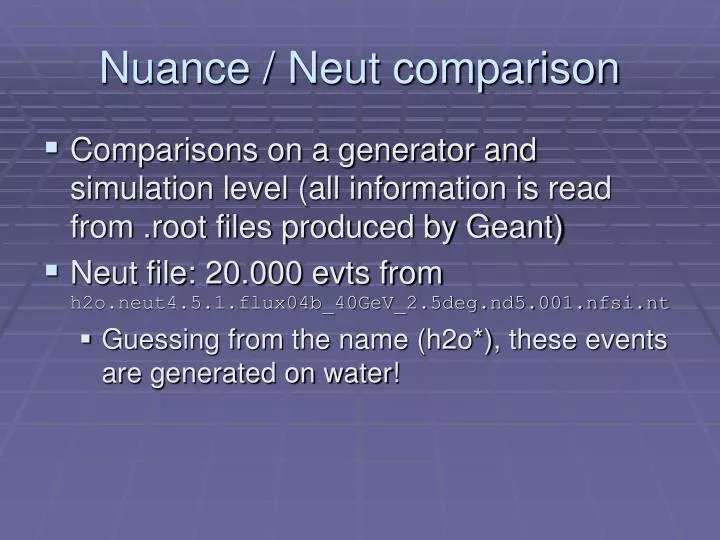
Nuance / Neut comparison • Comparisons on a generator and simulation level (all information is read from .root files produced by Geant) • Neut file: 20.000 evts from h2o.neut4.5.1.flux04b_40GeV_2.5deg.nd5.001.nfsi.nt • Guessing from the name (h2o*), these events are generated on water!
Generator/Simulation: Number of muons (all and primary) • Less muons in neut (<Nneut>=0.71, <Nnuance>=0.75) nuance neut
Generator/Simulation: Number of protons (all and primary) • Less protons in neut (<Nneut>=1.1, <Nnuance>=1.5 for primary protons) – a significant difference nuance neut
Generator: Momentum distributions of primary muons and protons • Muons much softer in neut nuance neut
Simulation: Number of muon hits in SMRD per event • Vertices in the whole detector (including the magnet) • Slightly less hits for neut nuance neut
Notes for neut files • Sometimes (25evts in 20000) the trajectory container is missing (??)
Some questions • The detector is situated off-axis. This means that the flux may change from top to bottom. As far as I understand this is not taken into account in the simulation (the distribution of vertices depends on the material density only). Am I right? • The detector is 2.5deg off-axis, but it’s large enough to catch neutrinos from (very approx.) 1.75deg to 3.25deg (this is including the magnet; 2.20 to 2.80 for the basket). This may influence the energy spectrum. I’m not sure whether this was taken into account in Neut files that we’re now using.
![Data Modeling [Comparison of data modeling techniques ]](https://cdn0.slideserve.com/205866/data-modeling-comparison-of-data-modeling-techniques-dt.jpg)