Exploring the Unique Properties and Uses of Erbium: A Comprehensive Overview
60 likes | 196 Vues
Erbium, a rare earth element, is known for its diverse applications and interesting properties. It is often added to other metals to reduce hardness and is widely used as a pink colorant in glass and porcelain glazes. This versatile element is also significant in the nuclear industry and photography due to its unique optical properties. With a boiling point of 2510°C and a density of 8.795 g/cm³, erbium is notable for its grayish coloration and hexagonal crystal structure. Discovered in 1842 by Gustav Mosander, erbium is sourced from minerals like monazite and bastnaesite.


Exploring the Unique Properties and Uses of Erbium: A Comprehensive Overview
E N D
Presentation Transcript
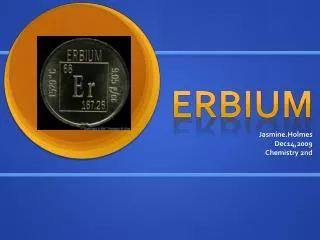
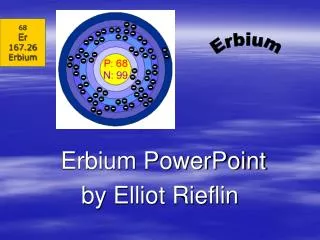
Erbium Erbium PowerPoint by Elliot Rieflin
Uses for Erbium • It may be added to other metals to lower hardness. • Erbium oxide is used as a pink colorant in glass • Erbium oxide is also used as a pink colorant in porcelain glaze • Nuclear industry • Photographic filter
Properties of Erbium • Boiling Point: 2510.0 °C (4550.0 °F) • density 8.795 g/cm3 • Color: grayish • Atomic Weight 167.26 • Crystal Structure: Hexagonal
Facts about Erbium • Named after the village of "Ytterby" near Vaxholm in Sweden • Klemm and Bommer- first to produce pure Erbium • Originally discovered by Gustav Mosander • Year of discovery 1842 • Interesting fact, cost when pure= 270 $ • It’s sources are the metals, Monazite, and bastnaesite
Bibliography • http://www.chemicalelements.com/index.html • http://chemistry.allinfoabout.com/periodic/periodictable.html • http://www.webelements.com/webelements/scholar/elements/periodic-table/uses.html • http://www.chemicool.com/ • http://chemistry.about.com/library/blper5.htm