Download
1 / 1
10 likes | 127 Vues
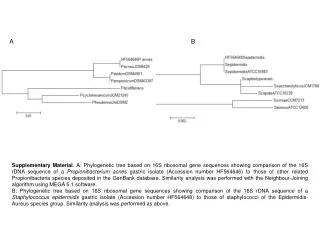
This study presents phylogenetic trees based on 16S ribosomal gene sequences, highlighting the relationships of gastric isolates of Propionibacterium acnes (Accession number HF564646) and Staphylococcus epidermidis (Accession number HF564648) to other Propionibacteria and staphylococci, respectively. The similarity analysis was conducted using the Neighbour-Joining algorithm implemented in MEGA 5.1 software, offering insights into the evolutionary connections among these species, crucial for understanding their roles in gastric microbiota and potential clinical implications.

E N D
A B Supplementary Material. A: Phylogenetic tree based on 16S ribosomal gene sequences showing comparison of the 16S rDNA sequence of a Propionibacterium acnes gastric isolate (Accession number HF564646) to those of other related Propionibacteria species deposited in the GenBank database. Similarity analysis was performed with the Neighbour-Joining algorithm using MEGA 5.1 software. B: Phylogenetic tree based on 16S ribosomal gene sequences showing comparison of the 16S rDNA sequence of a Staphylococcus epidermidis gastric isolate (Accession number HF564648) to those of staphylococci of the Epidermidis-Aureus species group. Similarity analysis was performed as above.