
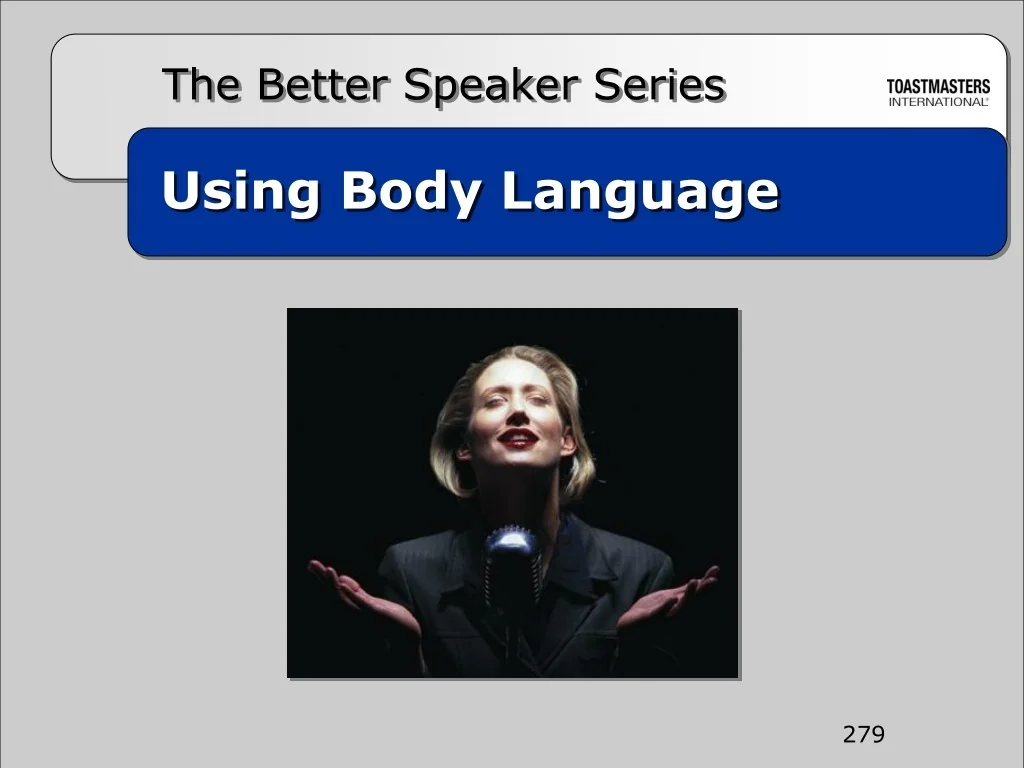
Mastering Effective Body Language for Public Speaking Success

Discover the power of body language for public speaking success. Learn to utilize facial expressions, gestures, and body movements to communicate attitudes, feelings, and emotions effectively. Enhance your speech delivery by incorporating good eye contact, conveying sincerity, attention, honesty, confidence, and respect. Explore different types of gestures and how to vary your position strategically during presentations for impactful communication.
Télécharger la présentation 
Politique de téléchargement : le contenu du site vous est fourni TEL QUEL pour votre information et votre usage personnel ; il ne peut être vendu, concédé sous licence ni partagé sur d’autres sites sans l’accord de son auteur.Le contenu vous est fourni TEL QUEL, pour votre information et votre usage personnel uniquement. Téléchargez la présentation en cliquant sur ce lien. Lors du téléchargement, si vous ne parvenez pas à télécharger une présentation, l’éditeur a peut-être supprimé le fichier de son serveur.Pendant le téléchargement, si vous ne parvenez pas à obtenir une présentation, le fichier a peut-être été supprimé par l’éditeur.
F I N