
Antianginal Agents
E N D
Presentation Transcript
Antianginal Agents • Nitrates • Beta blockers • Calcium channel blockers
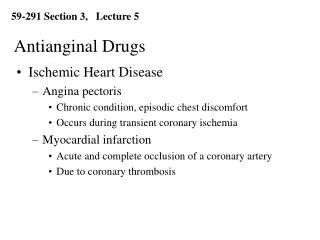
Angina Pectoris (Chest Pain) • When the supply of oxygen and nutrients in the blood is insufficient to meet the demands of the heart, the heart muscle aches. • The heart demands a large supply of oxygen to meet the demands placed on it.
Types of Angina • Chronic stable angina (also called classic or effort angina) • Unstable angina(also called preinfarction or crescendo angina) • Vasospastic angina(also called Prinzmetal’s or variant angina)
Instructors may wish to insert EIC Image # 68: Angina Drug Therapy
Antianginal Agents: Therapeutic Objectives • Increase blood flow to ischemic heart muscle and/or • Decrease myocardial oxygen demand
Antianginal Agents: Therapeutic Objectives • Minimize the frequency of attacks and decrease the duration and intensity of anginal pain • Improve the patient’s functional capacity with as few side effects as possible • Prevent or delay the worst possible outcome, MI
Antianginal Agents: Nitrates Available forms: Sublingual Ointments Buccal Transdermal patches Chewable tablets Inhalable sprays Capsules Intravenous solutions
Antianginal Agents: Nitrates • Cause vasodilation due to relaxation of smooth muscles • Potent dilating effect on coronary arteries • Used for prophylaxis and treatment of angina
Antianginal Agents: Nitrates Nitroglycerin • Prototypical nitrate • Large first-pass effect with PO forms • Used for symptomatic treatment of ischemic heart conditions (angina) • IV form used for BP control in perioperative hypertension, treatment of CHF, ischemic pain, and pulmonary edema associated with acute MI
Antianginal Agents: Nitrates • isosorbide dinitrate (Isordil, Sorbitrate, Dilatrate SR) • isosorbide mononitrate (Imdur, Monoket, ISMO) Used for: • Acute relief of angina • Prophylaxis in situations that may provoke angina • Long-term prophylaxis of angina
Antianginal Agents: Nitrates Side Effects • Headache • Usually diminish in intensity and frequency with continued use • Tachycardia, postural hypotension • Tolerance may develop
Antianginal Agents: Beta Blockers • atenolol (Tenormin) • metoprolol (Lopressor) • propranolol (Inderal) • nadolol (Corgard)
Antianginal Agents: Beta Blockers Mechanism of Action • Decrease the HR, resulting in decreased myocardial oxygen demand and increased oxygen delivery to the heart • Decrease myocardial contractility, helping to conserve energy or decrease demand
Antianginal Agents: Beta Blockers Therapeutic Uses • Antianginal • Antihypertensive • Cardioprotective effects, especially after MI
Antianginal Agents: Beta Blockers Side Effects Body System Effects Cardiovascular bradycardia, hypotension second- or third-degree heart block heart failure Metabolic Altered glucose and lipid metabolism
Antianginal Agents: Beta Blockers Side Effects Body System Effects CNS dizziness, fatigue, mental depression, lethargy, drowsiness, unusual dreams Other impotence wheezing, dyspnea
Antianginal Agents: Calcium Channel Blockers • verapamil (Calan) • diltiazem (Cardizem) • nifedipine (Procardia)
Antianginal Agents: Calcium Channel Blockers Mechanism of Action • Cause peripheral arterial vasodilation • Reduce myocardial contractility (negative inotropic action) • Result: decreased myocardial oxygen demand
Antianginal Agents: Calcium Channel Blockers Therapeutic Uses • First-line agents for treatment of angina, hypertension, and supraventricular tachycardia • Short-term management of atrial fibrillation and flutter • Several other uses
Antianginal Agents: Calcium Channel Blockers Side Effects • Very acceptable side effect and safety profile • May cause hypotension, palpitations, tachycardia or bradycardia, constipation, nausea, dyspnea
Antianginal Agents: Nursing Implications • Before administering, perform a complete health history to determine presence of conditions that may be contraindications for use or call for cautious use. • Obtain baseline VS, including respiratory patterns and rate. • Assess for drug interactions.
Antianginal Agents: Nursing Implications • Patients should not take any medications, including OTC medications, without checking with the physician. • Patients should report blurred vision, persistent headache, dry mouth, dizziness, edema, fainting episodes, weight gain of 2 pounds in 1 day or 5 or more pounds in 1 week, pulse rates under 60, and any dyspnea.
Antianginal Agents: Nursing Implications • Alcohol consumption and hot baths or spending time in jacuzzis, hot tubs, or saunas will result in vasodilation, hypotension, and the possibility of fainting. • Teach patients to change positions slowly to avoid postural BP changes. • Encourage patients to keep a record of their anginal attacks, including precipitating factors, number of pills taken, and therapeutic effects.
Antianginal Agents: Nitroglycerin Nursing Implications • Instruct patients in proper technique and guidelines for taking sublingual NTG for anginal pain. • Instruct patients never to chew or swallow the SL form. • Instruct patients that a burning sensation felt with SL forms indicates that the drug is still potent.
Antianginal Agents: Nitroglycerin Nursing Implications • Instruct patients to keep a fresh supply of NTG on hand; potency is lost in about 3 months after the bottle has been opened. • Medications should be stored in an airtight, dark glass bottle with a metal cap and no cotton filler to preserve potency.
Antianginal Agents: Nitroglycerin Nursing Implications • Instruct patients in the proper application of nitrate topical ointments and transdermal forms, including site rotation and removal of old medication. • To reduce tolerance, the patient may be instructed to remove topical forms at bedtime, and apply new doses in the morning, allowing for a nitrate-free period.
Antianginal Agents: Nitroglycerin Nursing Implications • Instruct patients to take prn nitrates at the first hint of anginal pain. • If experiencing chest pain, the patient taking SL NTG should be lying down to prevent or decrease dizziness and fainting that may occur due to hypotension. • Monitor VS frequently during acute exacerbations of angina and during IV administration.
Antianginal Agents: Nitroglycerin Nursing Implications • IV forms of NTG must be contained in glass IV bottles and must be given with infusion pumps. • Discard parenteral solution that is blue, green, or dark red. • Follow specific manufacturer’s instructions for IV administration. Use special IV tubing provided or non-PVC tubing.
Antianginal Agents: Calcium Channel Blockers Nursing Implications • Blood levels should be monitored to ensure they are therapeutic. • Oral CCBs should be taken before meals and as ordered. • Patients should be encouraged to limit caffeine intake.
Antianginal Agents: Beta Blockers Nursing Implications • Patients taking beta blockers should monitor pulse rate daily and report any rate lower than 60 beats per minute. • Dizziness or fainting should also be reported. • Constipation is a common problem. Instruct patients to take in adequate fluids and eat high-fiber foods.
Antianginal Agents: Beta Blockers Nursing Implications • These medications should never be abruptly discontinued due to risk of rebound hypertensive crisis. • Inform patients that these medications are for long-term prevention of angina, not for immediate relief.
Antianginal Agents: Nursing Implications • Monitor for adverse reactions • Allergic reactions, headache, light-headedness, hypotension, dizziness • Monitor for therapeutic effects • Relief of angina, decreased BP, or both