Understanding Irony: Expectations vs. Reality in Literature
Irony is a literary device representing the contrast between what is expected and what actually occurs. There are three main types of irony: dramatic irony, where the audience knows something characters don’t; verbal irony, where the speaker says the opposite of what they mean; and situational irony, where reality defies expectations. To analyze situational irony, use the formula: "I EXPECTED…BECAUSE…BUT IN REALITY…". This guide provides examples and insights into how irony functions within narratives and everyday life, enhancing both understanding and appreciation.

Understanding Irony: Expectations vs. Reality in Literature
E N D
Presentation Transcript
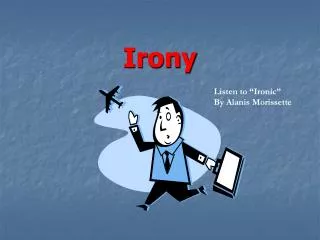
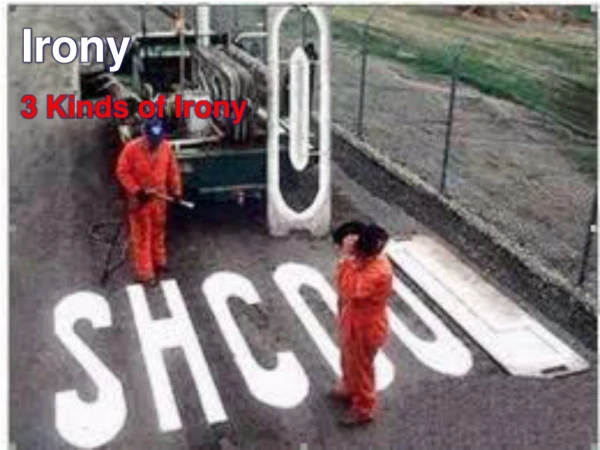
Irony The contrast between expectation/appropriateness and reality
Kinds of Irony: • Dramatic • Audience or reader knows something important but the characters do not • Verbal • Speaker says one thing but means the opposite • Situational • Reality is not what was expected or appropriate
Formula • In order to ensure that you get full credit for your examples of irony we will be using this formula for situational irony (the most popular in real life) for the remainder of the year. • I EXPECTED…BECAUSE…BUT IN REALITY…
Example: • You walk into an old fashioned diner in which the décor is done mostly in coca-cola products. Coca-cola is definitely a dominant fixture is this diner. Yet, when you ask the waitress for an ice-cold coca-cola, she replies that they only serve Pepsi products. • You expected the diner to serve coca-cola because they are advertising it everywhere and yet in reality, they serve Pepsi (coke’s greatest competitor) instead.
You would expect Alanis Morrisette’s song titled “Isn’t it Ironic?” to actually provide examples of irony, because that its what the title implies, but in reality it doesn’t!
Let’s Practice • It's a black fly in your Chardonnay • What would you expect? • Why? • But what really happened? • Use the formula!
It’s a death row pardon two minutes too late • It's like rain on your wedding day • It's a free ride when you've already paid • It's the good advice that you just didn't take
A traffic jam when you're already late • A no-smoking sign on your cigarette break • It's like ten thousand spoons when all you need is a knife • It's meeting the man of my dreams And then meeting his beautiful wife
Quick Quiz • Irony is… a. The logical chain of events in a story b. The difference between what we expect and what actually happens c. The most important element in the story d. The writer’s expression of personal opinions
The essence of irony is • Fear • Surprise • Pride • Hope
When a character says one thing but means something else, there is • Verbal irony • Situational irony • Dramatic irony • Critical thinking
In cases of situational irony • the expected happens • Comical moments always develop • Chance often plays a profound role • Tragedy is inevitable
Dramatic irony occurs when • The characters shock the audience • The writer tricks the characters • The audience knows something that the characters do not know • Tragedy is inevitable