Union Activities and Strikes in Washington: Historical Perspectives and Economic Impact
This chapter explores the concept of labor unions in Washington, highlighting the Industrial Workers of the World (IWW) and their unique approach to worker rights. It discusses significant union strikes in the region, examining their causes and outcomes for both workers and management. The chapter also reviews the economic impact of World War I on Washington state, including shifts in workforce demographics. Additionally, it covers the Seattle General Strike and public perceptions surrounding labor movements, including fears of a communist takeover.

Union Activities and Strikes in Washington: Historical Perspectives and Economic Impact
E N D
Presentation Transcript
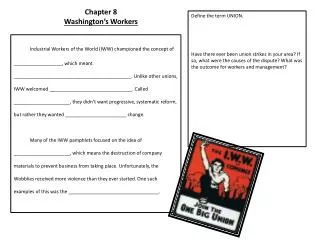
Chapter 8 Washington’s Workers Define the term UNION. Have there ever been union strikes in your area? If so, what were the causes of the dispute? What was the outcome for workers and management? Industrial Workers of the World (IWW) championed the concept of __________________, which meant ____________________________________________. Unlike other unions, IWW welcomed _______________________________. Called _____________________, they didn’t want progressive, systematic reform, but rather they wanted _______________________ change. Many of the IWW pamphlets focused on the idea of _____________________, which means the destruction of company materials to prevent business from taking place. Unfortunately, the Wobblies received more violence than they ever started. One such examples of this was the __________________________________.
World War I What were the two sides of World War I? V. Which countries fought on each side? V. Why did the Wobblies (IWW) oppose the war? Explain the Sedition Act.
Economic Boom from WWI How did the war help Washington’s economy? Who was able to work in the absence of men, who had left for war? Which Washington company became Washington’s largest industry? What happened to the state economy after the war? Explain how supply and demand was a factor. Explain what happened during the Seattle General Strike. Why did Americans think that strikers might be part of a communist takeover?