SlideServe
Menu
Préférences
© SlideServe · v2026

Chlorination of Propane

noelani-mcconnell avatar
10 diapositives · 847 Views · Nov 28, 2014

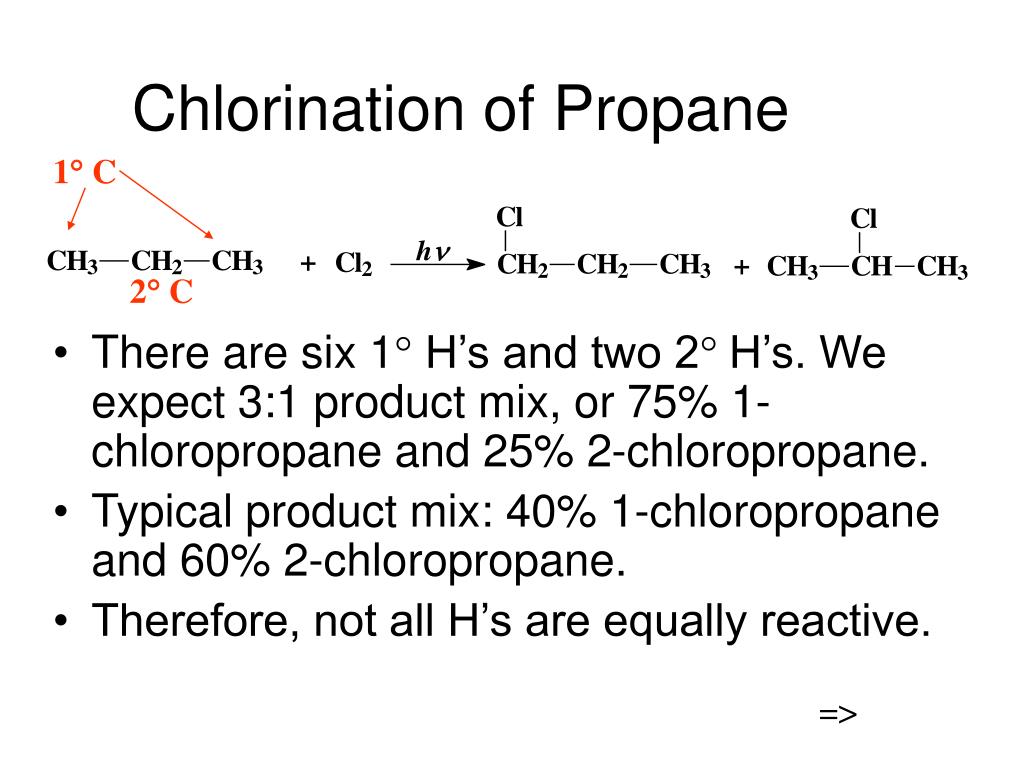
Chlorination of Propane. 1  C. There are six 1  H’s and two 2  H ’s. We expect 3:1 product mix, or 75% 1-chloropropane and 25% 2-chloropropane. Typical product mix: 40% 1-chloropropane and 60% 2-chloropropane. Therefore, not all H’s are equally reactive. =>. 2  C.

Chlorination of Propane - slide 1
01 / 10Chlorination of Propane
1 / 17

Télécharger la présentation

Chlorination of Propane
Une image / un lien ci-dessous est fourni (tel quel) pour télécharger la présentation

Politique de téléchargement : le contenu du site vous est fourni TEL QUEL pour votre information et votre usage personnel ; il ne peut être vendu, concédé sous licence ni partagé sur d’autres sites sans l’accord de son auteur.Le contenu vous est fourni TEL QUEL, pour votre information et votre usage personnel uniquement. Téléchargez la présentation en cliquant sur ce lien. Lors du téléchargement, si vous ne parvenez pas à télécharger une présentation, l’éditeur a peut-être supprimé le fichier de son serveur.Pendant le téléchargement, si vous ne parvenez pas à obtenir une présentation, le fichier a peut-être été supprimé par l’éditeur.

F I N

Plus de contenu associé

Transcription de la présentation
  1. Chlorination of Propane 1 C • There are six 1 H’s and two 2 H’s. We expect 3:1 product mix, or 75% 1-chloropropane and 25% 2-chloropropane. • Typical product mix: 40% 1-chloropropane and 60% 2-chloropropane. • Therefore, not all H’s are equally reactive. => 2 C

  2. Reactivity of Hydrogens • To compare hydrogen reactivity, find amount of product formed per hydrogen: 40% 1-chloropropane from 6 hydrogens and 60% 2-chloropropane from 2 hydrogens. • 40%  6 = 6.67% per primary H and60%  2 = 30% per secondary H • Secondary H’s are 30%  6.67% = 4.5 times more reactive toward chlorination than primary H’s. =>

  3. Free Radical Stabilities • Energy required to break a C-H bond decreases as substitution on the carbon increases. • Stability: 3 > 2 > 1 > methylDH(kJ) 381, 397, 410, 435 =>

  4. Chlorination Energy Diagram Lower Ea, faster rate, so more stable intermediate is formed faster. =>

  5. Bromination of Propane 1 C 2 C • There are six 1 H’s and two 2 H’s. We expect 3:1 product mix, or 75% 1-bromopropane and 25% 2-bromopropane. • Typical product mix: 3% 1-bromopropane and 97% 2-bromopropane !!! • Bromination is more selective than chlorination. =>

  6. Reactivity of Hydrogens • To compare hydrogen reactivity, find amount of product formed per hydrogen: 3% 1-bromopropane from 6 hydrogens and 97% 2-bromopropane from 2 hydrogens. • 3%  6 = 0.5% per primary H and97%  2 = 48.5% per secondary H • Secondary H’s are 48.5%  0.5% = 97 times more reactive toward bromination than primary H’s. =>

  7. Bromination Energy Diagram • Note larger difference in Ea • Why endothermic? • BDE for HBr is 368 kJ, but 431 kJ for HCl =>

  8. Bromination vs. Chlorination =>

  9. Endothermic and Exothermic Diagrams =>

  10. Hammond Postulate • Related species that are similar in energy are also similar in structure. The structure of a transition state resembles the structure of the closest stable species. • Endothermic reaction: transition state is product-like. • Exothermic reaction: transition state is reactant-like.=>