China's Historical Turmoil: From Imperial Rule to Communist Revolution
Explore China's turbulent history from the last Qing Emperor to Mao's Cultural Revolution, including wars, political movements, and societal upheavals leading to the rise of Communist power.

China's Historical Turmoil: From Imperial Rule to Communist Revolution
E N D
Presentation Transcript
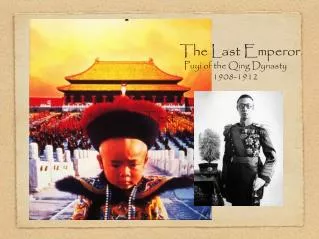
The Last Emperor Puyi of the Qing Dynasty 1908-1912 Text
Sun Yatsen The Republic of China Reality: rule by War Lords
Sun Yatsen and Jiang Jieshu Leaders of the Guomindang
Early Years of Republic May 4 Movement (1917): student-led; frustration with Japan; disappointment with Versailles Guomindang works closely with USSR
Jiang Jieshi or Chiang Kai-shek
1930’s: Civil War between Nationalists and Communists In addition, the Japanese are making inroads into China
Late 1930’s - 1945: A Common Enemy: Mao and Jiang Jieshi “join forces” Communists (CCP) happy to let Nationalists do the real fighting
The Great Leap Forward: 1958 In the end: up to 38 million died of starvation and relocation “Production first: Life takes second place.”
Mao on the Great Leap Forward: On peasants: “Educate peasants to eat less, and have more thin gruel.” On the 38 million deaths: “Deaths have benefits. They can fertilize the ground.” (or) We are prepared to sacrifice 300 million Chinese for the victory of the world revolution. Don’t make a fuss (over this). At most - people die ...it’s best if half the population is left.”
On loyalty: “My farts are socialist farts, they have to be fragrant.”
Out with the Old: “Growing flowers is a hangover from the old society, a pastime for the scholar class, bourgeois class, and other layabouts. We must change it now. Get rid of most gardeners.” Anti-Intellectual: “The more books you read, the more stupid you become. Reading too much ruins you.”
“Poisonous Weeds”: porcelain Opera dance Really, really bad: any kind of western art Theater cinema poetry Folk Art Story telling literature comics all music, except songs praising CCP and Mao traditional architecture