Enhancing Team Performance: Insights and Strategies from ECE194
In evaluating team performance from ECE194, consistent feedback highlights both strengths and challenges. Students recognized effective collaboration and diverse contributions, noting that working well together led to innovative solutions. However, issues arose with certain members' reliability and motivation, impacting group dynamics. To address these challenges, guidelines suggest proactively anticipating problems, fostering group cohesion, and establishing clear communication norms. Emphasizing collective responsibility and constructive feedback mechanisms can empower teams to navigate difficulties more effectively and enhance overall performance.

Enhancing Team Performance: Insights and Strategies from ECE194
E N D
Presentation Transcript
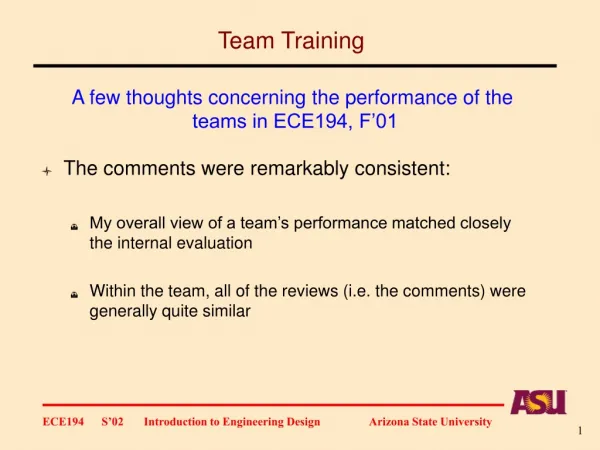
Team Training A few thoughts concerning the performance of the teams in ECE194, F’01 • The comments were remarkably consistent: • My overall view of a team’s performance matched closely the internal evaluation • Within the team, all of the reviews (i.e. the comments) were generally quite similar
Team Training • Review of last year’s comments • “Our team really worked well together” • “Each of us contributed along the way” • “We were all pretty different and that helped us come up with some pretty good ideas” • “Everyone shared responsibility and effort”
Team Training • Review of last year’s comments, cont. • “X missed presentations and meetings out of class, he wasn’t very reliable, and he showed up late if at all.” • “Y did not attend the meetings or help with the written report” • “I was very disappointed that my ‘teammates’ could just not get motivated”
Team Training Guidelines for reacting to group problems • Anticipate and prevent group problems whenever possible • If a group spends time developing itself into a team, many problems can be anticipated and prevented. • Get to know each other • Establish ground rules • Discuss norms for group behavior • Agree to an improvement plan
Team Training • Think of each problem as a group problem
Team Training • Neither over-react nor under-react • Your team must learn to differentiate between fleeting disruptions and chronic behaviors. • A range of responses can include: • Do nothing (non-intervention, appropriate for fleeting disruptions) • Off-line conversation (minimal intervention) outside the group meeting, using constructive feedback techniques • Impersonal group time (low intervention) inside the group meeting, focusing attention on the problem, not the offender • Off-line confrontation (medium intervention) outside the group meeting, which is similar to off-line conversation, but more assertive. • In-group confrontation (high intervention), but with constructive feedback techniques