Multiple Access Links and Protocols
This overview covers the fundamental concepts of multiple access links and protocols in the Data Link Layer, emphasizing point-to-point, broadcast, and switched links. It explores multiple access protocols, focusing on distributed algorithms that manage channel sharing to avoid collisions. The taxonomy of MAC protocols is discussed, including channel partitioning (TDMA, FDMA, CDMA) and random access methods (ALOHA, CSMA/CD), along with issues like collision detection and recovery. The implications of latency, overhead, and efficiency in high and low-load scenarios are also examined.

Multiple Access Links and Protocols
E N D
Presentation Transcript
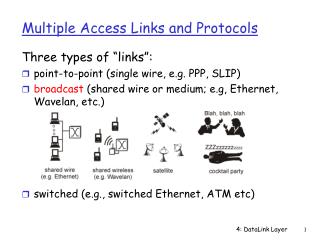
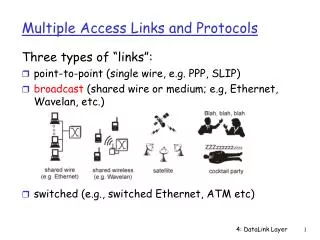
Multiple Access Links and Protocols Three types of “links”: • point-to-point (single wire, e.g. PPP, SLIP) • broadcast (shared wire or medium; e.g, Ethernet, Wavelan, etc.) • switched (e.g., switched Ethernet, ATM etc) 4: DataLink Layer
Multiple Access protocols • single shared communication channel • two or more simultaneous transmissions by nodes: interference • only one node can send successfully at a time • multiple access protocol: • distributed algorithm that determines how stations share channel, i.e., determine when station can transmit • communication about channel sharing must use channel itself! • what to look for in multiple access protocols: • synchronous or asynchronous • information needed about other stations • robustness (e.g., to channel errors) • performance 4: DataLink Layer
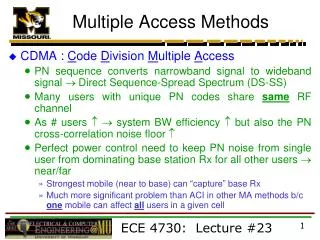
MAC Protocols: a taxonomy Three broad classes: • Channel Partitioning • TDMA: time division multiple access • FDMA: frequency division multiple access • CDMA (Code Division Multiple Access) Read! • Random Access • allow collisions • “recover” from collisions • “Taking turns” • tightly coordinate shared access to avoid collisions Goal: efficient, fair, simple, decentralized 4: DataLink Layer
Random Access protocols • When node has packet to send • transmit at full channel data rate R. • no a priori coordination among nodes • two or more transmitting nodes -> “collision”, • random access MAC protocol specifies: • how to detect collisions • how to recover from collisions (e.g., via delayed retransmissions) • Examples of random access MAC protocols: • slotted ALOHA and ALOHA • CSMA and CSMA/CD 4: DataLink Layer
CSMA: Carrier Sense Multiple Access) CSMA: listen before transmit: • If channel sensed idle: transmit entire pkt • If channel sensed busy, defer transmission • Persistent CSMA: retry immediately with probability p when channel becomes idle (may cause instability) • Non-persistent CSMA: retry after random interval • human analogy: don’t interrupt others! 4: DataLink Layer
CSMA collisions spatial layout of nodes along ethernet collisions can occur: propagation delay means two nodes may not year hear each other’s transmission collision: entire packet transmission time wasted note: role of distance and propagation delay in determining collision prob. 4: DataLink Layer
CSMA/CD (Collision Detection) CSMA/CD: carrier sensing, deferral as in CSMA • collisions detected within short time • colliding transmissions aborted, reducing channel wastage • persistent or non-persistent retransmission • collision detection: • easy in wired LANs: measure signal strengths, compare transmitted, received signals • difficult in wireless LANs: receiver shut off while transmitting • human analogy: the polite conversationalist 4: DataLink Layer
CSMA/CD collision detection 4: DataLink Layer
“Taking Turns” MAC protocols channel partitioning MAC protocols: • share channel efficiently at high load • inefficient at low load: delay in channel access, 1/N bandwidth allocated even if only 1 active node! Random access MAC protocols • efficient at low load: single node can fully utilize channel • high load: collision overhead “taking turns” protocols look for best of both worlds! 4: DataLink Layer
“Taking Turns” MAC protocols Token passing: • control token passed from one node to next sequentially. • token message • concerns: • token overhead • latency • single point of failure (token) Polling: • master node “invites” slave nodes to transmit in turn • Request to Send, Clear to Send msgs • concerns: • polling overhead • latency • single point of failure (master) 4: DataLink Layer
Summary of MAC protocols • What do you do with a shared media? • Channel Partitioning, by time, frequency or code • Time Division,Code Division, Frequency Division • Random partitioning (dynamic), • ALOHA, S-ALOHA, CSMA, CSMA/CD • carrier sensing: easy in some technologies (wire), hard in others (wireless) • CSMA/CD used in Ethernet • Taking Turns • polling from a central cite, token passing 4: DataLink Layer