Essential Terms in U.S. History: A Comprehensive Guide
This guide presents key terms and concepts crucial to understanding U.S. history, from abolitionists and electoral college to federalism and secession. Each entry provides a concise definition of important historical terms that shaped the nation, covering various themes including governance, civil rights, warfare, and economic principles. The text offers an excellent resource for students, educators, and history enthusiasts looking to enhance their knowledge of American history through accessible definitions and context.

Essential Terms in U.S. History: A Comprehensive Guide
E N D
Presentation Transcript
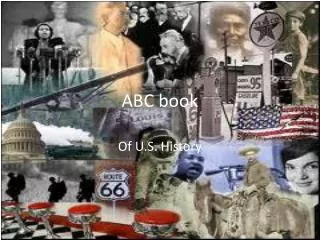
ABC book Of U.S. History
A’s • Abolitionists-People who strongly don’t want slavery. • Abstain- Not to take park in an activity. • Arsenal-Storage for guns and or ammo.
B’s • Blockade Runner-ship that goes in and out of blockade lines. • Bounty-Money given as a reward. • Burgesses-Elected representatives go to an assembly.
C’s • Canal-artificial water way. • Cash Crop-Farm crop sold for money. • Constitution- Formal plan of government.
D’s • Debtor- Person or country that owes money. • Decree- Order or decision given by authority. • Depreciate-Fall in value
E’s • Electoral college- Elected voters who vote for presidency. • Emancipate-Free From Slavery. • Export-Sell goods away.
F’s • Federalism- sharing power between the government and Feds. • Frigate-Warship • Fugitive-Runaway
G’s • Genocide-Destruction of a “Different” group. • Guerilla tactics-Hiding and ambushing. • Guerilla warfare- Hit and Run technique.
H’s • Holocaust-Mass slaughter of Jew in WW2. • Horizontal Integration-Combining of two Corporations to make one. • Human Rights-Rights to all people.
i’s • Impeach-charge official with misconduct in office. • Imperialism-Actions from one nation to show dominance over a smaller nation. • Import- Buy incoming goods from away.
J’s • Jackson, Andrew- 7th president, dealt with many conflicts in the war. • Jefferson, Thomas-3rd president, wrote “The Declaration Of Independence.” • Judicial Review-A review on judicial placing.
K’s • Kansas- Central state, fought over slavery issue. • Kentucky-South central state, sided w/ Union. • Key, Francis- Attorney, wrote the “Star Spangled Banner.”
L’s • Literacy- The ability to read and write. • Log Cabin Campaign- Name given to W. Harrison’s campaign for the 1840 presidency symbol. • Loyalists- Colonists still loyal to Great Britain.
M’s • Majority-More then half. • Mercenary- Soldier that serves for a foreign country. • Militia- Group of civilians trained to fight in emergencies.
N’s • Neutral- taking neither sides. • Nomads- People who move from area to area. • Nullify-Make ineffective.
O’s • Offensive- Attack • Ordinance- Regulation • Override- Overturn
P’s • Pacifist- Opposed to war and violence. • Plurality- Largest single share. • Precedent- a tradition.
Q’s • Quakers- open to religion. • Quartering of troops- give troops what they need to live. • Quechua- and Incan Language.
R’s • Radical- EXTREME! • Rancho- Mexican settler made property. • Repeal- cancel and act or law.
S’s • Secede- Leave or withdraw. • States’ rights- Right given to states for themselves to level out the governments power. • Strike- Stopping to work because of conditions.
T’s • Tariff-Tax on imports or exports. • Tejano-Mexican that resides to Texas. • Tribute- Money paid for protection.
U’s • Unalienable rights- A right that cannot be surrendered. • Unconstitutional- Not agreeing with the constitution. • Utopia- Perfect society.
V’s • Vaquero- Hispanic Ranch Hand. • Veto- Reject a bill. • Vigilantes- People who take law into there own hands.
W’s • War Hawks- people who wanted to fight GB again during Madison's presidency. • Writ of assistance- Legal document needed to search houses. • Washington, Martha- 1st 1st lady. George Washington’s wife.
X’s • XYZ Affair- Adam’s urged wars referring to French agents X, Y, Z.
Y • Yankee- Union Soldier. • Yellow Journalism- A type of Sensational false reporting. • Yeoman- Southern owner of a small farm who did not have enslaved people.
Z • Zenger , John Peter-Journalist for the New York weekly journal. Gave important step to free press.