Download
1 / 23
230 likes | 345 Vues
This project explores the relationship between socio-economic disadvantage and road safety in Australia, particularly focusing on how low income and barriers to opportunities correlate with higher injury rates in transport-related incidents. Through data analysis and literature review, the project aims to identify key factors contributing to road trauma among disadvantaged populations. It discusses existing interventions and proposes recommendations for targeted actions to enhance road safety for vulnerable groups, including Indigenous communities, young drivers, and those in remote areas.

E N D
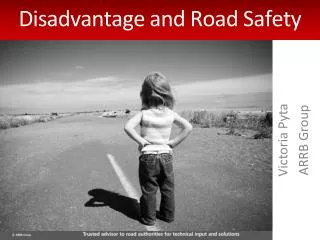
Disadvantage and Road Safety Victoria Pyta ARRB Group
Background • Objectives • Definition of disadvantage Project Overview
Background • Austroads project SS1761 (2012 – 2015) • Literature review • Data analysis and modelling • Consultation • Project Team: • Project Technical Leader: Victoria Pyta (ARRB) • Project Manager: Anita Baruah (VicRoads) • Quality Manager: Dr Peter Cairney (ARRB)
What is disadvantage? • What is disadvantage? • Low income relative to others and/or expenditure on necessities • Barriers to education, social opportunities or work • A ‘relative’ and ‘multi-dimensional’ concept • How is disadvantage related to road safety? • Socio-economic disadvantage is associated with higher injury rates due to transport-related injuries.
Effects of disadvantage on road trauma • Factors that are associated with both disadvantage and road trauma • Interventions Literature review
Victoria, Australia • Victorian Injury Surveillance Unit • Transport injuries represent 14% of all injuries in the hospital admissions data • Persons with greatest risk come from the 2nd and 3rd quintiles
New South Wales, Australia • Remoteness and low SES associated with increased risk of death among young drivers Rural fatalities Low SES fatalities • Higher posted speed limits • Fatigue • Drink-driving • Seatbelt non-use • Higher posted speed limits • Fatigue • Driving an older vehicle
Indigenous populations of Australia and New Zealand • Among most severely disadvantaged • High road fatality rate compared to non-indigenous populations • Cultural and language differences Australia New Zealand • Drink driving • Unlicensed driving • Remoteness amplifies problems and accounts for much of the disparity • Over-representation is particularly strong among 15-24 year olds • Disparities persist after accounting for differences in SES
International • Many studies (UK, Europe, Israel, USA) • Disadvantage associated with higher risk, particularly for child pedestrians • Concomitant factors: • Environmental, e.g. location (especially remoteness), exposure • Behavioural factors, e.g. unlicensed driving, drug and alcohol use • Socio-cultural factors, i.e. peer group and culture • Personal factors, e.g. health, self-efficacy
Existing interventions • Low income earners (registration discounts and discounts on drink drive programs) • Indigenous communities (wide range) • CALD communities (translation, education and awareness raising, licensing assistance) • Young drivers (supervised practice, first car safety) • Children (proper restraint use and early childhood road safety education) • Engineering treatments • Enforcement and diversionary programs • Partnerships and community engagement
Data sources • Results so far (exploratory descriptive analysis) • Next steps, methods and data sources Data Analysis
Data sources (Australia) • Crash data with postcode of crash involved persons • Vic, NSW, SA • NZ (needs to be geocoded) • SES data • ABS Index of Relative Social Disadvantage (IRSD) • Remoteness data • ABS remoteness index • Potential for inclusion of travel survey data • e.g. ABS Survey of Motor Vehicle Use (SMVU)
Index of Relative Social Disadvantage (Australia) • Takes into account: • Income • Household occupancy • Vehicle ownership • Illness and disability • % of residents speaking LOTE • % of residents of indigenous origin • Etc.
Looking forward Years 2 and 3
Remainder of 2013 – Modelling • Develop model for crash risk associated with SES that takes into account: • Demographic profile of area • Remoteness • Environmental factors (e.g. speed limits) • Individual demographic factors (age, gender etc.) • Behavioural factors (e.g. restraint use) • Other explanatory factors (e.g. vehicle age)
2014/15 • detailed consultationregarding the operation of programs for disadvantaged groups or locations • develop recommendationsfor actions to address these issues
Acknowledgements • Data providers in road agencies • SS1761 Project Team: • Dr Peter Cairney, Principal Behavioural Scientist (ARRB) • Anita Baruah, Senior Policy Analyst, Road Safety and Network Access (VicRoads) • Project steering committee • Supervisor • Dr Lyndon Walker, Swinburne University victoria.pyta@arrb.com.au +61 3 9881 1640