

SlideServe
Menu
Préférences
© SlideServe · v2026

Character Analysis

norina avatar
9 diapositives · 393 Views · Jul 23, 2014

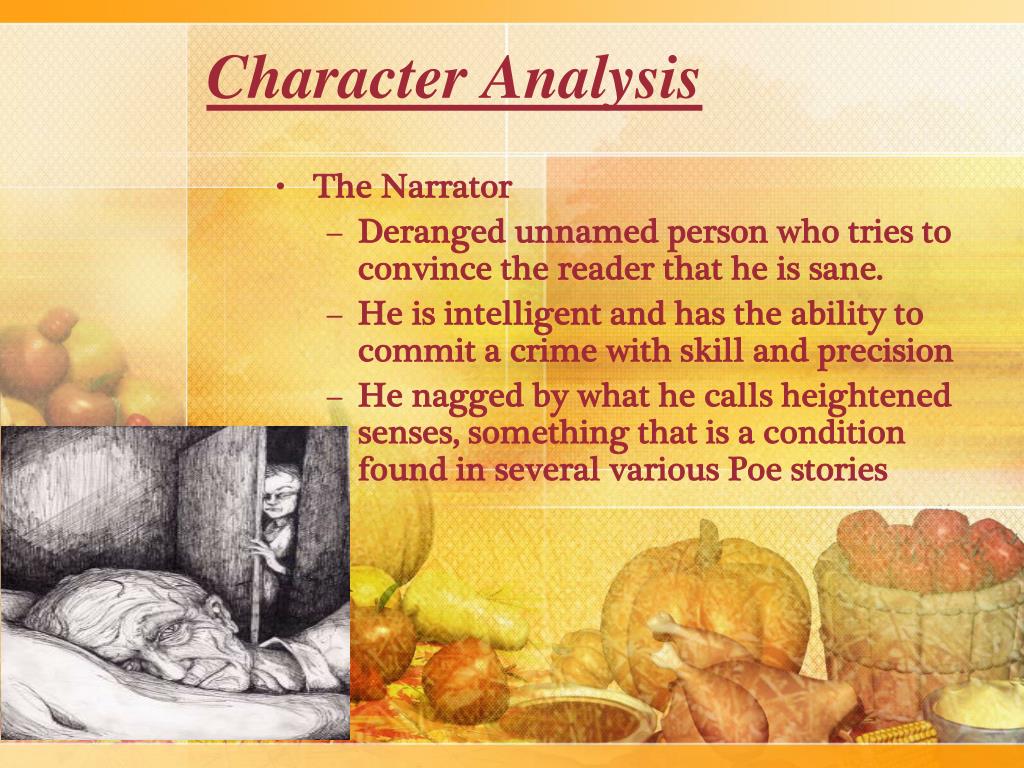
Character Analysis . The Narrator Deranged unnamed person who tries to convince the reader that he is sane. He is intelligent and has the ability to commit a crime with skill and precision
Character Analysis - slide 1
01 / 9Character Analysis
1 / 17

Télécharger la présentation

Character Analysis
Une image / un lien ci-dessous est fourni (tel quel) pour télécharger la présentation

Politique de téléchargement : le contenu du site vous est fourni TEL QUEL pour votre information et votre usage personnel ; il ne peut être vendu, concédé sous licence ni partagé sur d’autres sites sans l’accord de son auteur.Le contenu vous est fourni TEL QUEL, pour votre information et votre usage personnel uniquement. Téléchargez la présentation en cliquant sur ce lien. Lors du téléchargement, si vous ne parvenez pas à télécharger une présentation, l’éditeur a peut-être supprimé le fichier de son serveur.Pendant le téléchargement, si vous ne parvenez pas à obtenir une présentation, le fichier a peut-être été supprimé par l’éditeur.

F I N

Plus de contenu associé

Transcription de la présentation
  1. Character Analysis The Narrator Deranged unnamed person who tries to convince the reader that he is sane. He is intelligent and has the ability to commit a crime with skill and precision He nagged by what he calls heightened senses, something that is a condition found in several various Poe stories 

  2. Character Analysis The Old Man: Neighbor: Three Policemen: Seemingly harmless elder who has a hideous "evil eye" that unnerves the narrator.  Person who hears a shriek coming from the house of the narrator and the old man, then reports it to the police.  Officers who search the narrator's house after a neighbor reports hearing a shriek

  3. Mood “The Tell Tale Heart”

  4. Mood • Definition: • The feeling or impression the author creates with his writing • Also refers to the feelings the reader has about the characters or setting in a story • Mood can be identified by analyzing the setting of a story and by analyzing the character’s actions and dialogue

  5. Identifying Mood through Character’s Words and Actions • Readers need to recognize/analyze the following: • Situation in which the character is involved • Character’s reactions to the situation • Character’s reactions by other characters • Character’s body language • Character’s tone of voice • What the characters say to and about others • The character’s thoughts and emotions

  6. Identifying Mood through Analyzing Setting • Writers often select/create a setting that will impart the mood they wish to instill in their readers • Writers will use a variety of imagery devices to vividly describe the setting so that the readers can picture in their minds how the setting looks, smells, sounds, etc.: sensory details, simile, metaphor, personification

  7. Words to Describe Mood • Just about any word that can describe an emotion can describe the mood in a story. The following list is just some examples • Cheerful Humerous • Tense Dark Light • Terror Apprehensive Suspenseful • Melancholy Romantic Anxious • Dreary Mysterious Sad • Violent Exciting Angry • Peaceful Lonely Fearful • Scary Calm • Ominous Cold

  8. Steps to Identifying Mood • Identify the situation—what is the character doing? • Find the key words and phrases that show the character’s reactions to the situation • Ask yourself: What mood is shown by the character’s reactions?

  9. Why Mood Matters • Mood is an important literary element because it influences the way readers feel about what they are reading • Mood can draw a reader into a story and can compel a reader to continue to read.