Advancing the Hull Offshore Wind Project: Future Directions and Research Opportunities
The Hull Offshore Wind Project, directed by Prof. J. F. Manwell at the Wind Energy Center, UMass Amherst, presents promising steps forward despite economic challenges. With successful integration of energy production, research, and education, the project emphasizes building a monitoring platform, turbine testing, and environmental studies. Options to collaborate with the Massachusetts Offshore Wind Energy Center and the FINO platform model in Germany are explored. Key research areas include permitting, feasibility studies, wind/wave monitoring, public acceptance, and the economic impact of offshore wind energy.

Advancing the Hull Offshore Wind Project: Future Directions and Research Opportunities
E N D
Presentation Transcript
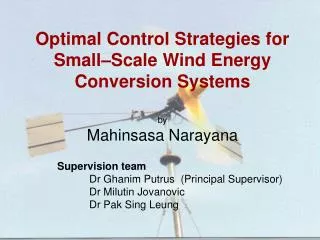
Hull Offshore Wind Project: Next Steps J. F. Manwell, Prof. and Director Wind Energy Center (a.k.a Renewable Energy Research Laboratory) University of Massachusetts Amherst May 12, 2011
Status of Original Project • No fatal flaws • Economics difficult • Transforming project to mixture of energy production, demonstration, research and education most interesting
Options • Build on progress to date • Monitoring platform with cable to shore • Pre-set foundations for testing offshore wind turbines • Some number of primarily energy producing turbines • Integrate Hull project with proposed Massachusetts Offshore Wind Energy Center
Research Platform • Consider FINO platform (Germany) as model • Environmental studies • Meteorologic/oceanographic • LIDAR, ADCP, RADAR • Transformer/switch gear for any wind turbines • Cable (power and data) to shore
Turbine Test Platform • Large gravity structure in shallow water (e.g. Harding Ledge) could allow various turbines to be installed, tested and removed • Power/data to research platform
Possible Research Projects • Permitting/Feasibility Stage • Continued wind and wave monitoring • Support structure studies • Cost estimation • Environmental monitoring • Public acceptance
Possible Research Projects(2) • Studies during construction • Continued wind and wave monitoring • Environmental monitoring • Public acceptance studies • Documentation of the process
Possible Research Projects(3) • Studies during operation • Structural response • Wind and wave monitoring • Environmental monitoring • Energy production • Turbine wake studies (if multiple turbines) • Air quality benefits • Operation and maintenance • Electrical studies • Economic assessments • Public acceptance • Policy studies