Understanding Narrative Perspective: Exploring Points of View in Storytelling
This educational text delves into the concept of the narrator in storytelling, outlining who the narrator can be and the significance of their point of view. It discusses the three main perspectives—first-person, second-person, and third-person—and provides examples to illustrate how each affects the narrative. Additionally, it includes a personal reflection from an Indigenous perspective, emphasizing pride in cultural identity and traditions. By understanding the narrator and their point of view, readers can better appreciate the intricacies of storytelling.

Understanding Narrative Perspective: Exploring Points of View in Storytelling
E N D
Presentation Transcript
Point of View Reading A. Ibarra, Clinton MS
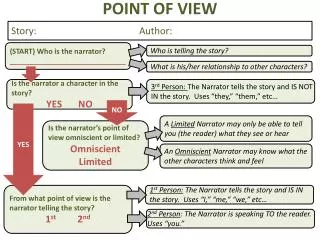
Who is the “narrator?” • The narrator is the person who is telling the story. • Sometimes the narrator is the author – someone who is not in the story. • Sometimes the narrator is a character in the story. • Sometimes the narrator is the author, and they are in the story. A. Ibarra, Clinton MS
What is the “narrator’s point of view?” • The narrator’s point of view describes how a story is being told. • Identifying the narrator’s point of view helps us understand the story, because we know who is telling the story. A. Ibarra, Clinton MS
Different Points of View • Different points of view use different pronouns. • The three points of view are: • First-person • Second-person • Third-person A. Ibarra, Clinton MS
First-person Point of View • Stories that describe the writer’s own life are called “first-person” stories. I am writing a story for my English class. My characters are very interesting. I want to make it exciting. A. Ibarra, Clinton MS
First-person Point of View • In this kind of story, the narrator uses first-person pronouns. my I our me A. Ibarra, Clinton MS
Second-person Point of View • When the writer is talking to someone else, we call that “second-person.” • Almost no stories are written this way. You are writing a story for your English class. Your characters are very interesting. You want to make it exciting. A. Ibarra, Clinton MS
Second-person Point of View • In this kind of writing, the narrator uses second-person pronouns. you your A. Ibarra, Clinton MS
Third-person Point of View • Stories that tell about other people’s lives are called third-person stories. She is writing a story for her English class. Her characters are very interesting. She wants to make it exciting. A. Ibarra, Clinton MS
Third-person Point of View • The narrator uses third-person pronouns. he she they A. Ibarra, Clinton MS
“I’m Native American, or Indian. Usually, I say Indian. I have an Indian name I got in the sweat lodge when I was an itty bitty baby. It means something like Mother Earth. I’m proud to be Indian, because that’s what the Creator brought me down to be. I really enjoy the traditions and customs, the feasts, and the ceremonies, like the salmon ceremony. You can’t go fishing for salmon unless you have the ceremony first. And I love being at the powwows.” - Janell A. Ibarra, Clinton MS