Eigenvector and Eigenvalue Calculation Guide: Steps and Tools for Solution
This guide provides a comprehensive overview of calculating eigenvalues and eigenvectors using polynomial equations and systems of linear equations. Learn how to compute eigenvalues by setting the determinant to zero and how to find eigenvectors through Gaussian elimination and back-substitution. The guide includes practical examples with a 3x3 matrix, online calculators, and software tools like MATLAB and Mathematica. Further resources for deepening your understanding of complex numbers and Gaussian elimination are also provided.

Eigenvector and Eigenvalue Calculation Guide: Steps and Tools for Solution
E N D
Presentation Transcript
Eigenvector and Eigenvalue Calculation Norman Poh
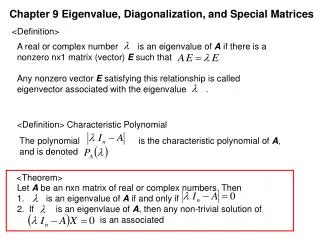
Steps • Compute the Eigenvalues by solving polynomial equations to get eigenvalues • det() and set it to zero • If is an n-by-n matrix, you have to solve a polynomial of degree n • Compute the Eigenvectors by solving a system of linear equations via Gaussian elimination • For each eigenvalue • Reduce the matrix to a triangular form • Apply back-substitution • Normalise the vector
A walk-through example • An example for solving a 3x3 matrix: • http://www.sosmath.com/matrix/eigen2/eigen2.html • A calculator with a step-by-step solution using your own matrix: • http://karlscalculus.org/cgi-bin/linear.pl • Not useful for solving Eigenvectors as it ends up with a trivial solution of 0 but you should stop before the last step. • Another one but does not always work: • http://easycalculation.com/matrix/eigenvalues-and-eigenvectors.php
What tools you can use? • Matlab symbolic solver • Mathematica • Maple • Online • Expression simplifier: • http://www.numberempire.com/simplifyexpression.php • Equation solver: • http://www.numberempire.com/equationsolver.php
An example • Compute the Eigenvalues for: • Compute det() and set it to zero • Simplify the expression: • (4-x)*((2-x)*(3-x)-1) - ( (3-x)-3) - 3*(-1+ 3 * (2-x)) • Solve it using an equation solver by setting it to zero • Evaluate the solutions in Octave/Matlab
A screenshot from http://www.numberempire.com/equationsolver.php
Trick • Don’t worry about the complex numbers. In this case, they are all real! You can be converted into real numbers using the following rules: • Further reference: • http://www.intmath.com/complex-numbers/4-polar-form.php
Matlab/Octave example (demo) i=sqrt(-1) r(1) = (-sqrt(3)*i/2-1/2)*(sqrt(15)*i+7)^(1/3)+4*(sqrt(3)*i/2-1/2)/(sqrt(15)*i+7)^(1/3)+3 r(2) = (sqrt(3)*i/2-1/2)*(sqrt(15)*i+7)^(1/3)+4*(-sqrt(3)*i/2-1/2)/(sqrt(15)*i+7)^(1/3)+3 r(3) = (sqrt(15)*i+7)^(1/3)+4/(sqrt(15)*i+7)^(1/3)+3 %in this example, we know the eigenvalues are all real, so we can do this: real(r) %Not sure, check: m=[4 1 -3 1 2 -1 -3 -1 3] eig(m) %by convention, we sort the eigenvalues
An example (4-x)*((2-x)*(3-x)-1) - ( (3-x)-3) - 3*(-1+ 3 * (2-x))
Further references • http://en.wikipedia.org/wiki/Gaussian_elimination
More on Complex numbers • http://www.intmath.com/complex-numbers/5-exponential-form.php