Understanding Truth Tables, Equivalent Statements, and Logical Operations
This guide explores the fundamentals of truth tables and logical statements in propositional logic. It covers the truth values of conjunctions (AND), disjunctions (OR), and negations (NOT), providing step-by-step examples for constructing truth tables. Utilizing logical statements, like p and q, this material illustrates how to determine truth values for complex expressions, such as conjunctions and disjunctions, in varied scenarios. Additionally, it explains equivalent statements and their significance in logical reasoning and problem-solving.

Understanding Truth Tables, Equivalent Statements, and Logical Operations
E N D
Presentation Transcript
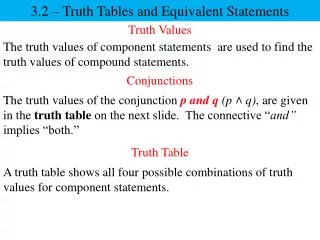
3.2 – Truth Tables and Equivalent Statements Conjunctions Truth Values The truth values of component statements are used to find the truth values of compound statements. The truth values of the conjunction p and q (p ˄ q), are given in the truth table on the next slide. The connective “and” implies “both.” Truth Table A truth table shows all four possible combinations of truth values for component statements.
3.2 – Truth Tables and Equivalent Statements Conjunction Truth Table p and q
3.2 – Truth Tables and Equivalent Statements Finding the Truth Value of a Conjunction If p represent the statement 4 > 1 and q represent the statement 12 < 9, find the truth value of p ˄ q. p and q 4 > 1 p is true 12 < 9 q is false The truth value for p ˄ q is false
3.2 – Truth Tables and Equivalent Statements Disjunctions The truth values of the disjunction p or q (p˅q) are given in the truth table below. The connective “or” implies “either.” Disjunction Truth Table p or q
3.2 – Truth Tables and Equivalent Statements Finding the Truth Value of a Disjunction If p represent the statement 4 > 1, and q represent the statement 12 < 9, find the truth value of p˅q. p or q 4 > 1 p is true 12 < 9 q is false The truth value for p ˅ q is true
3.2 – Truth Tables and Equivalent Statements Negation The truth values of the negation of p( ̴ p) are given in the truth table below. not p
3.2 – Truth Tables and Equivalent Statements Example: Constructing a Truth Table Construct the truth table for: p ˄ (~ p ˅ ~ q) A logical statement having n component statements will have 2n rows in its truth table. 22 = 4 rows
3.2 – Truth Tables and Equivalent Statements Example: Constructing a Truth Table Construct the truth table for: p ˄ (~ p ˅ ~ q) A logical statement having n component statements will have 2n rows in its truth table. 22 = 4 rows
3.2 – Truth Tables and Equivalent Statements Example: Constructing a Truth Table Construct the truth table for: p ˄ (~ p ˅ ~ q) A logical statement having n component statements will have 2n rows in its truth table. 22 = 4 rows
3.2 – Truth Tables and Equivalent Statements Example: Constructing a Truth Table Construct the truth table for: p ˄ (~ p ˅ ~ q) A logical statement having n component statements will have 2n rows in its truth table. 22 = 4 rows
3.2 – Truth Tables and Equivalent Statements Example: Constructing a Truth Table Construct the truth table for: p ˄ (~ p ˅ ~ q) A logical statement having n component statements will have 2n rows in its truth table. 22 = 4 rows
3.2 – Truth Tables and Equivalent Statements Example: Mathematical Statements If p represent the statement 4 > 1, and q represent the statement 12 < 9, and r represent 0 < 1, decide whether the statement is true or false. ̴ p ˄ ̴ q
3.2 – Truth Tables and Equivalent Statements Example: Mathematical Statements If p represent the statement 4 > 1, and q represent the statement 12 < 9, and r represent 0 < 1, decide whether the statement is true or false. ̴ p ˄ ̴ q
3.2 – Truth Tables and Equivalent Statements Example: Mathematical Statements If p represent the statement 4 > 1, and q represent the statement 12 < 9, and r represent 0 < 1, decide whether the statement is true or false. ̴ p ˄ ̴ q The truth value for the statement is false.
3.2 – Truth Tables and Equivalent Statements Example: Mathematical Statements If p represent the statement 4 > 1, and q represent the statement 12 < 9, and r represent 0 < 1, decide whether the statement is true or false. ( ̴ p ˄ r) ˅ ( ̴ q ˄ p)
3.2 – Truth Tables and Equivalent Statements Example: Mathematical Statements If p represent the statement 4 > 1, and q represent the statement 12 < 9, and r represent 0 < 1, decide whether the statement is true or false. ( ̴ p ˄ r) ˅ ( ̴ q ˄ p)
3.2 – Truth Tables and Equivalent Statements Example: Mathematical Statements If p represent the statement 4 > 1, and q represent the statement 12 < 9, and r represent 0 < 1, decide whether the statement is true or false. ( ̴ p ˄ r) ˅ ( ̴ q ˄ p)
3.2 – Truth Tables and Equivalent Statements Example: Mathematical Statements If p represent the statement 4 > 1, and q represent the statement 12 < 9, and r represent 0 < 1, decide whether the statement is true or false. ( ̴ p ˄ r) ˅ ( ̴ q ˄ p)
3.2 – Truth Tables and Equivalent Statements Example: Mathematical Statements If p represent the statement 4 > 1, and q represent the statement 12 < 9, and r represent 0 < 1, decide whether the statement is true or false. ( ̴ p ˄ r) ˅ ( ̴ q ˄ p) The truth value for the statement is true.
3.2 – Truth Tables and Equivalent Statements Equivalent Statements Two statements are equivalent if they have the same truth value in every possible situation. Are the following statements equivalent? ~ p ˄ ~ q and ̴ (p ˅ q)
3.2 – Truth Tables and Equivalent Statements Equivalent Statements Two statements are equivalent if they have the same truth value in every possible situation. Are the following statements equivalent? ~ p ˄ ~ q and ̴ (p ˅ q)
3.2 – Truth Tables and Equivalent Statements Equivalent Statements Two statements are equivalent if they have the same truth value in every possible situation. Are the following statements equivalent? ~ p ˄ ~ q and ̴ (p ˅ q) Yes