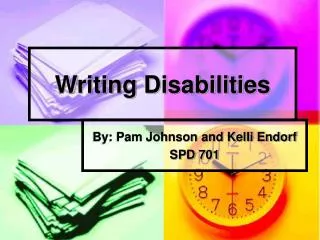
Unit 5 - Writing Disabilities
170 likes | 295 Vues
This comprehensive guide explores the three key areas of written expression: handwriting, spelling, and composition, emphasizing the impact of dysgraphia and other writing disabilities. It details characteristics of students with writing difficulties, like poor letter formation and fluency issues, and outlines effective assessment methods and interventions. By implementing curriculum-based assessments, self-evaluation, and targeted instructional strategies, educators can better support students struggling with writing. Insights into spelling errors and composition problems provide a holistic understanding of written language difficulties.


Unit 5 - Writing Disabilities
E N D
Presentation Transcript
Unit 5 - Writing Disabilities Prepared by: CiciliaEviGradDiplSc., M. Psi
Brief Introduction • 3 major areas of written expression handwriting, spelling, composition • Dysgraphia written language disorder that concerns with mechanical writing skills manifest in poor writing performance • Characteristics of students with dysgraphia p. 408
Writing Problems (WP) • Letter formation malformations, poor spacing, extremely slow writing • Far-point copying & near-point copying • Reversal errors common when children are first learning to read and write • Fluency so slow, seems to draw each letter • Poor handwriting can cause lack of spelling skills due to eligibility and speed of writing
Assessment on WP • No need of formal assessment • Examine students’ writing and identify parts that need further instructional work • Point of copying far or near • P. 412 table 13.1
Monitoring the Progress of WP • Curriculum-based assessments designed to evaluate performance in the particular curriculum to which the students are exposed • Probing from teachers ask students to write in specific period of time score the results • Self-evaluation improves the quality of handwriting using plastic overlays showing the correct form of the letters
Intervention for WP • Manuscript or cursive ???? • Teacher modeling and student practice p. 413 • Reinforcement effective for ‘near cure’ oriented • Self-instruction training part of CBT self-guiding statement and self-correction procedure
Spelling Problem (SP) • Spelling error through spelling test, dictation • Read p. 417 characteristics • Effects : • Hamper handwriting and vice versa
Assessment of SP • Basic methods (p. 418): • Dictation – connected writing – recognition • Standardized assessments
Intervention for SP • Effective VS less effective spelling instructional practice p. 422 • Remedial intervention p. 425 • Effective Teaching Procedures • Test – Study – Test • Practice Procedure • Time Delay • Morphographic Spelling • Add-a-Word
Composition Problems (CP) • Read characteristics on p. 428-429 • Fig 13.4 p. 429 • Assessment : • Screening difficult • Planning Composition Instruction • Monitoring regular evaluation on students’ composition samples
Intervention for CP • Expression OR traditional aspects of writing?? • Developmental intervention: • Label cut-out pictures and put in their books • Then, writing one sentence about the picture • Followed by two-sentence descriptions • Three-sentence or longer descriptions • Write thematically • Basic for instruction p. 435
Intervention for CP (2) • Six principle to prevent and address writing difficulties p. 435 and table 13.3 • Remedial intervention expressive writing • Effective teaching procedure: • Self-regulated strategy development p. 438 • Learning Strategy Interventions • Explicit teaching of steps in writing process • Explicit teaching on the conventions of a writing genre