Download
1 / 18
180 likes | 286 Vues
This document outlines the top-level requirements and implementation guidelines for the ERL facility, focusing on beam quality preservation, cooling channel delivery, and technology boundaries. It covers system configuration, layout characteristics, optics, and challenges like power deposition and beam dynamics. Key aspects include common cooling channel geometry and beam transfer systems for three ERL options. The text highlights the need for gymnastics in longitudinal aspect ratio and betatron matching between segments. Challenges like RF harmonics and multiparticle simulations are discussed.

E N D
Top Level Requirements • Deliver properly configured periodic train of bunches to cooling channel at appropriate repetition rate • 54 MeV • Few mm-mrad • 0.01% x ~ 1 cm • 2 nC • Rep rate of 750 MHz/N, N=1,10,100… • Manage stray power deposition, instabilities; preserve beam quality • Recover it Very similar to FEL requirements (but with longitudinal phase space rotated 90o)
Implementation Requirements • System configuration/geometry consistent with MEIC collider • 2 x 30 m 2 kG solenoids; figure X layout • ½ m vertical separation Perform design exercise to explore technology boundaries and beam dynamical limitations
System Configuration • Three options • 750 MHz ERL (high risk source) • 75 MHz ERL (moderate risk source & beam transfer, high risk beam-beam interaction) • 7.5 MHz ERL (high risk beam transfer) • All three use common cooling channel geometry • All three use similar beam transfer system • Single DC dipole for 750 MHz ERL • Pair of RF separators/single septum for 75 MHz ERL • Pair of ultrafast kickers/single septum for 7.5 MHz ERL
recirculation/decompression transport dump CCR dechirper beam exchange system ERL cooling solenoids rechirper injector recovery/recompression transport System Layout
ERL Characteristics • 4 five-cell 750 MHz SRF cavities • Existing JLab high current design • Longitudinal aspect ratio at CCR imposes some degree of gymnastics • Harmonic RF problematic • Chirp/compress/dechirp before injection • Use transport system compactions for linear/nonlinear compensation • Chirp/decompress/energy compress during recovery • Use transport system compactions for linear/nonlinear compensation • Betatron matching between/amongst functional modules
CCR Concept • Use common figure-8 layout for all 3 ERL options • 2 x 30 m 20 kG cooling solenoids • Round beam matched to cooling channels • FODO arcs, asymmetric chicane vertical steps • Compactions cancel isochronous transport • Betatron matching between/amongst segments • Beam transfer: 2 x 90 FODO cells • Single dipole at center in 750 MHz ERL option • RFS/fast kickers at ends, septum in center in 75, 7.5 MHz ERL option) • Cf. CEBAF beam distribution system
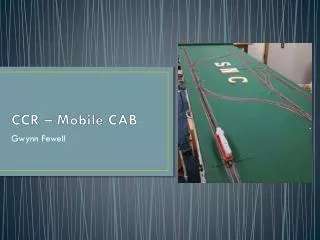
CCR layout • Figure 8, 30 m solenoids, ½ m vertical separation
CCR: 1000(+) particles x 100 turns • Added a few outliers to probe aperture
Cheats, Swindles, Things Left Undone • Matching to/from CCR “figurative” • Simply set ERL match to 1 m into/out of exchange dipole/septum; adjusted using Twiss matrix into/out of CCR & started simulation in middle of central quad in beam exchange section Still have to construct details of transfer for each case… • Path lengths not properly set • ½ lRF for full ERL • Multi-turn CCR needs to be multiple of lRF • Haven’t started sensitivity/aberration analyses • Matching poorly optimized
Now, the bad news… • 2 nC x 54 MeV is nontrivial… • CW MHz, rep rate, nsec-rise/fall time kickers nontrivial