Advanced Demonstration of Two-Stage Membrane System for Ethanol Recovery in Brazil
70 likes | 170 Vues
This report outlines the Phase 1 demonstration of the Siftek™ membrane technology, operated at a Cosan plant in São Paulo, Brazil, since September 2008. The system processes 5 m³/day utilizing a two-stage membrane module for ethanol recovery from a rectification column. Key performance metrics include an impressive 99.5% fuel-grade product output, energy savings of approximately 80% compared to molecular sieves, and flexible rack design for easy maintenance. This innovative design aims to optimize energy efficiency and reduce capital costs in ethanol production.


Advanced Demonstration of Two-Stage Membrane System for Ethanol Recovery in Brazil
E N D
Presentation Transcript
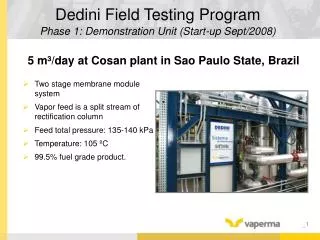
Dedini Field Testing ProgramPhase 1: Demonstration Unit (Start-up Sept/2008) 5 m³/day at Cosan plant in Sao Paulo State, Brazil • Two stage membrane module system • Vapor feed is a split stream of rectification column • Feed total pressure: 135-140 kPa • Temperature: 105 ºC • 99.5% fuel grade product.
Rack and Module Assembly • 2, 6, 12 et 24 modules per rack • Very flexible (in/out) • Compact design to minimize interconnection costs • Vertical mounting foreasy access
Energy Comparison SiftekTM vsMolecular Sieves Energy Savings 50 %
Membranes for Dehydration (MSU Replacement) • Typical feed: 90-93 wt% • Energy savings approximately 80% • Competitive CAPEX in comparison to MSU
25 80,000 Ethanol Low Heating Value 20 70,000 60,000 Low capital cost design 15 50,000 Low energy design 40,000 Énergy (BTU/gal) 10 Énergy (MJ/L) 30,000 20,000 5 Sugar cane Cellulosics 10,000 Corn 0 0 0 1 2 3 4 5 6 7 8 9 10 11 12 13 14 15 Ethanol in Feed (wt%) Thermal Energy to Recover Ethanol from Beer(CHEMCAD: two distillation columns + molecular sieve units to 99.3 wt%)