

SlideServe
Menu
Préférences
© SlideServe · v2026

The Space Program

nydia avatar
14 diapositives · 418 Views · Aug 09, 2014

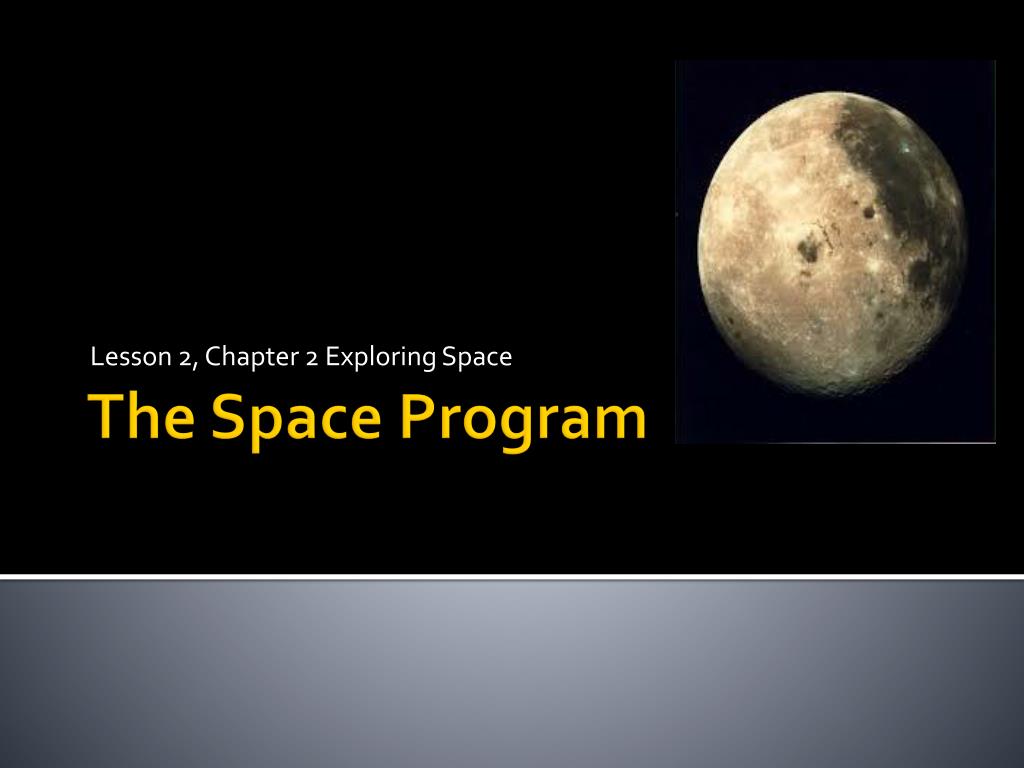
Lesson 2, Chapter 2 Exploring Space . The Space Program. The Race for Space. The space race began in 1957 when the Soviets launched the satellite Sputnik I into orbit. The United States responded by speeding up its own space program.
The Space Program - slide 1
01 / 14The Space Program
1 / 17

Télécharger la présentation

The Space Program
Une image / un lien ci-dessous est fourni (tel quel) pour télécharger la présentation

Politique de téléchargement : le contenu du site vous est fourni TEL QUEL pour votre information et votre usage personnel ; il ne peut être vendu, concédé sous licence ni partagé sur d’autres sites sans l’accord de son auteur.Le contenu vous est fourni TEL QUEL, pour votre information et votre usage personnel uniquement. Téléchargez la présentation en cliquant sur ce lien. Lors du téléchargement, si vous ne parvenez pas à télécharger une présentation, l’éditeur a peut-être supprimé le fichier de son serveur.Pendant le téléchargement, si vous ne parvenez pas à obtenir une présentation, le fichier a peut-être été supprimé par l’éditeur.

F I N

Plus de contenu associé

Transcription de la présentation
  1. Lesson 2, Chapter 2 Exploring Space The Space Program

  2. The Race for Space • The space race began in 1957 when the Soviets launched the satellite Sputnik I into orbit. The United States responded by speeding up its own space program. • A satellite is an object that revolves around another object in space. The moon is a natural satellite of Earth. • Sputnik I was the first artificial satellite.

  3. Sputnik I

  4. The First Artificial Satellites • The United States responded in early 1958 by launching its own satellite, Explorer I. • Later in 1958, the United States established a government agency in charge of the space program, called the National Aeronautics and Space Administration (NASA)

  5. Explorer I

  6. Humans in Space • In 1961 the space race heated up even more when the Soviets launched the first human into space. Yuri Gagarin flew one orbit around Earth aboard Vostok I • Less than a month later, astronaut Alan Shepard became the first American in space on the Freedom 7. • The first American to orbit Earth was John Glenn, was launched into space in 1962 aboard Friendship 7.

  7. Vostok I

  8. Freedom 7

  9. Friendship 7

  10. Missions to the Moon • The American effort to land astronauts on the moon was named the Apollo Program. • Between 1964 and 1972, the United States and the Soviet Union sent many unpiloted spacecraft to explore the moon. • In July 1969, three American astronauts circled the moon aboard Apollo 11. Once in orbit, Neil Armstrong and Buzz Aldrin entered a tiny spacecraft called Eagle.

  11. Apollo 11

  12. On July 20th, the Eagle descended toward a flat area on the moon’s surface known as the Sea of Tranquility.

  13. Moon Rocks and Moonquakes • The minerals that make up moon rocks are the same minerals found on Earth. However, in some moon rocks these minerals combine to form kinds of rocks that are not found on Earth. • One way scientists explored the structure of the moon was to purposely crash equipment onto the moon’s surface. Instruments they left behind measured the “moonquake” waves that resulted.

  14. New Missions to the Moon • The Apollo missions were a tremendous achievement. • The cost of missions were high. • In 2003 the European Space Agency launched an unpiloted spacecraft to orbit the moon. Its main purpose was to collect data for a detailed map of the moon. • In 2004, the United States announced a plan to establish a permanent colony of people on the moon.