Journey of Life: From Fertilization to Birth
530 likes | 563 Vues
Explore the stages of early and late embryonic development, pregnancy, and fetal growth from fertilization to birth, understanding key concepts such as meiosis, capacitation, implantation, and placenta formation.


Journey of Life: From Fertilization to Birth
E N D
Presentation Transcript
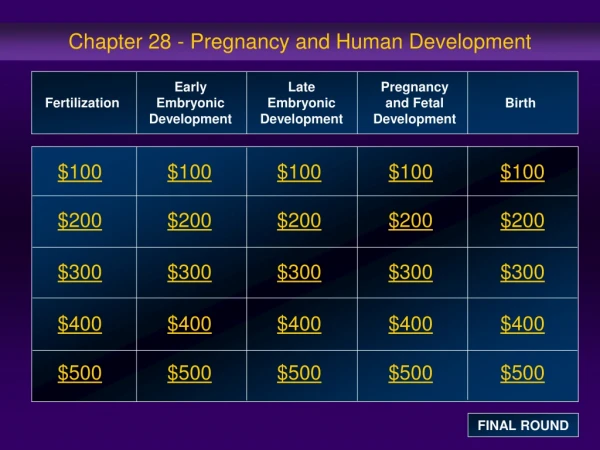
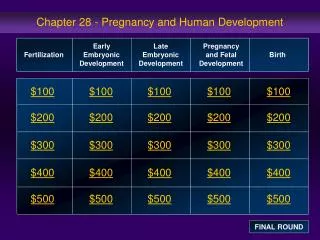
Chapter 28 - Pregnancy and Human Development Early Embryonic Development Late Embryonic Development Pregnancy and Fetal Development Fertilization Birth $100 $100 $100 $100 $100 $200 $200 $200 $200 $200 $300 $300 $300 $300 $300 $400 $400 $400 $400 $400 $500 $500 $500 $500 $500 FINAL ROUND
Fertilization:$100 Question • A fertilized egg is also called: • a. gamete • b. gastrula • c. oocyte • d. zygote ANSWER BACK TO GAME
Fertilization:$100 Answer • A fertilized egg is also called: • a. gamete • b. gastrula • c. oocyte • d. zygote BACK TO GAME
Fertilization:$200 Question • When, in the female, is meiosis II completed? • a. at birth • b. during embryonic development • c. at fertilization • d. at puberty ANSWER BACK TO GAME
Fertilization:$200 Answer • When, in the female, is meiosis II completed? • a. at birth • b. during embryonic development • c. at fertilization • d. at puberty BACK TO GAME
Fertilization:$300 Question • Capacitation refers to: • a. changes occurring in sperm before fertilization • b. changes occurring in sperm during fertilization • c. changes occurring in oocytes before fertilization • d. changes occurring in oocytes after fertilization ANSWER BACK TO GAME
Fertilization:$300 Answer • Capacitation refers to: • a. changes occurring in sperm before fertilization • b. changes occurring in sperm during fertilization • c. changes occurring in oocytes before fertilization • d. changes occurring in oocytes after fertilization BACK TO GAME
Fertilization:$400 Question • The ovulated oocyte is surrounded by an outer capsule called the: • a. acrosome • b. corona radiata • c. morula • d. alpha protein ANSWER BACK TO GAME
Fertilization:$400 Answer • The ovulated oocyte is surrounded by an outer capsule called the: • a. acrosome • b. corona radiata • c. morula • d. alpha protein BACK TO GAME
Fertilization:$500 Question • Monospermy is assured by the release of: • a. beta proteins • b. calcium • c. iron • d. alpha proteins ANSWER BACK TO GAME
Fertilization:$500 Answer • Monospermy is assured by the release of: • a. beta proteins • b. calcium • c. iron • d. alpha proteins BACK TO GAME
Early Embryonic Development:$100 Question • Which of the following is in the correct chronological order? • a. zygote, morula, blastocyst • b. zygote, blastocyst, morula • c. blastocyst, morula, zygote • d. morula, zygote, blastocyst ANSWER BACK TO GAME
Early Embryonic Development:$100 Answer • Which of the following is in the correct chronological order? • a. zygote, morula, blastocyst • b. zygote, blastocyst, morula • c. blastocyst, morula, zygote • d. morula, zygote, blastocyst BACK TO GAME
Early Embryonic Development:$200 Question • The end result of cleavage is a: • a. blastomere • b. blastocyst • c. morula • d. gastrula ANSWER BACK TO GAME
Early Embryonic Development:$200 Answer • The end result of cleavage is a: • a. blastomere • b. blastocyst • c. morula • d. gastrula BACK TO GAME
Early Embryonic Development:$300 Question • The embryo implants in the uterus as a: • a. zygote • b. blastocyst • c. morula • d. gastrula ANSWER BACK TO GAME
Early Embryonic Development:$300 Answer • The embryo implants in the uterus as a: • a. zygote • b. blastocyst • c. morula • d. gastrula BACK TO GAME
Early Embryonic Development:$400 Question • After fertilization a loose collection of cells form in the uterine tube. This cluster of cells is called a: • a. blastomere • b. blastocyst • c. morula • d. trophoblast ANSWER BACK TO GAME
Early Embryonic Development:$400 Answer • After fertilization a loose collection of cells form in the uterine tube. This cluster of cells is called a: • a. blastomere • b. blastocyst • c. morula • d. trophoblast BACK TO GAME
Early Embryonic Development:$500 Question • Which of the following develops into the embryonic disc? • a. cytotrophoblast • b. syncytiotrophoblast • c. inner cell mass • d. zona pellucida ANSWER BACK TO GAME
Early Embryonic Development:$500 Answer • Which of the following develops into the embryonic disc? • a. cytotrophoblast • b. syncytiotrophoblast • c. inner cell mass • d. zona pellucida BACK TO GAME
Late Embryonic Development:$100 Question • Which extraembryonic membrane contributes to the formation of the placenta? • a. allantois • b. amnion • c. chorion • d. yolk sac ANSWER BACK TO GAME
Late Embryonic Development:$100 Answer • Which extraembryonic membrane contributes to the formation of the placenta? • a. allantois • b. amnion • c. chorion • d. yolk sac BACK TO GAME
Late Embryonic Development:$200 Question • The notochord develops from the: • a. endoderm • b. mesoderm • c. ectoderm • d. chorion ANSWER BACK TO GAME
Late Embryonic Development:$200 Answer • The notochord develops from the: • a. endoderm • b. mesoderm • c. ectoderm • d. chorion BACK TO GAME
Late Embryonic Development:$300 Question • Which extraembryonic membrane contributes to the formation of the umbilical cord? • a. allantois • b. amnion • c. chorion • d. yolk sac ANSWER BACK TO GAME
Late Embryonic Development:$300 Answer • Which extraembryonic membrane contributes to the formation of the umbilical cord? • a. allantois • b. amnion • c. chorion • d. yolk sac BACK TO GAME
Late Embryonic Development:$400 Question • The neural tube and neural crest cells develop from the: • a. endoderm • b. mesoderm • c. ectoderm • d. milkman ANSWER BACK TO GAME
Late Embryonic Development:$400 Answer • The neural tube and neural crest cells develop from the: • a. endoderm • b. mesoderm • c. ectoderm • d. milkman BACK TO GAME
Late Embryonic Development:$500 Question • All of the following develop from somites except: • a. vertebrae • b. skeletal muscles • c. dermis • d. heart ANSWER BACK TO GAME
Late Embryonic Development:$500 Answer • All of the following develop from somites except: • a. vertebrae • b. skeletal muscles • c. dermis • d. heart BACK TO GAME
Pregnancy and Fetal Development:$100 Question • All of the following are metabolic changes that occur in pregnant women except: • a. increase in metabolic rate • b. negative calcium balance • c. metabolize more fatty acids • d. hPL helps breast maturation for lactation ANSWER BACK TO GAME
Pregnancy and Fetal Development:$100 Answer • All of the following are metabolic changes that occur in pregnant women except: • a. increase in metabolic rate • b. negative calcium balance • c. metabolize more fatty acids • d. hPL helps breast maturation for lactation BACK TO GAME
Pregnancy and Fetal Development:$200 Question • At the time of birth the uterus has enlarged to the level of the: • a. diaphragm • b. kidneys • c. xiphoid process • d. 12th rib ANSWER BACK TO GAME
Pregnancy and Fetal Development:$200 Answer • At the time of birth the uterus has enlarged to the level of the: • a. diaphragm • b. kidneys • c. xiphoid process • d. 12th rib BACK TO GAME
Pregnancy and Fetal Development:$300 Question • Nutrients are carried from the placenta to the fetus by the: • a. umbilical artery • b. umbilical vein • c. ductus arteriosus • d. ductus venosus ANSWER BACK TO GAME
Pregnancy and Fetal Development:$300 Answer • Nutrients are carried from the placenta to the fetus by the: • a. umbilical artery • b. umbilical vein • c. ductus arteriosus • d. ductus venosus BACK TO GAME
Pregnancy and Fetal Development:$400 Question • Chadwick’s sign refers to what changes during pregnancy? • a. increased pigmentation of facial skin • b. darkening of the areola • c. purplish hue of the vagina • d. lordosis and flaring of the ribs ANSWER BACK TO GAME
Pregnancy and Fetal Development:$400 Answer • Chadwick’s sign refers to what changes during pregnancy? • a. increased pigmentation of facial skin • b. darkening of the areola • c. purplish hue of the vagina • d. lordosis and flaring of the ribs BACK TO GAME
Pregnancy and Fetal Development:$500 Question • In the developing fetus all body systems are present by: • a. 8 weeks • b. 12 weeks • c. 20 weeks • d. 40 weeks ANSWER BACK TO GAME
Pregnancy and Fetal Development:$500 Answer • In the developing fetus all body systems are present by: • a. 8 weeks • b. 12 weeks • c. 20 weeks • d. 40 weeks BACK TO GAME
Birth:$100 Question • During late pregnancy and during labor the release of oxytocin is regulated by: • a. negative feedback • b. positive feedback • c. the sympathetic nervous system • d. the parasympathetic nervous system ANSWER BACK TO GAME
Birth:$100 Answer • During late pregnancy and during labor the release of oxytocin is regulated by: • a. negative feedback • b. positive feedback • c. the sympathetic nervous system • d. the parasympathetic nervous system BACK TO GAME
Birth:$200 Question • Which hormone is responsible for the milk let-down reflex? • a. prolactin • b. oxytocin • c. relaxin • d. progesterone ANSWER BACK TO GAME
Birth:$200 Answer • Which hormone is responsible for the milk let-down reflex? • a. prolactin • b. oxytocin • c. relaxin • d. progesterone BACK TO GAME
Birth:$300 Question • The infant’s head enters the true pelvis during this stage of labor. • a. crowning • b. effaces • c. engagement • d. presentation ANSWER BACK TO GAME
Birth:$300 Answer • The infant’s head enters the true pelvis during this stage of labor. • a. crowning • b. effaces • c. engagement • d. presentation BACK TO GAME
Birth:$400 Question • Which hormone stimulates the formation of oxytocin receptors on the uterus? • a. relaxin • b. progesterone • c. estrogen • d. prostaglandins ANSWER BACK TO GAME
Birth:$400 Answer • Which hormone stimulates the formation of oxytocin receptors on the uterus? • a. relaxin • b. progesterone • c. estrogen • d. prostaglandins BACK TO GAME
Birth:$500 Question • The ligamentum teres is the remnant of the: • a. umbilical arteries • b. umbilical vein • c. ductus venosus • d. ductus arteriosus ANSWER BACK TO GAME