Balancing Chemical Equations: Aluminum Oxide and Fluorine to Aluminum Fluoride and Oxygen
This resource provides a detailed overview of how to write and balance the chemical equation for the reaction between aluminum oxide and fluorine, producing aluminum fluoride and oxygen. It includes instructions for identifying superscripts (ionization), subscripts (molecular stoichiometry), and coefficients (balancing the equation). Learn systematic methods to ensure both sides of the equation are equal, along with a review of electronegativity and bond types. Essential for students studying covalent, ionic, and metallic compounds.

Balancing Chemical Equations: Aluminum Oxide and Fluorine to Aluminum Fluoride and Oxygen
E N D
Presentation Transcript
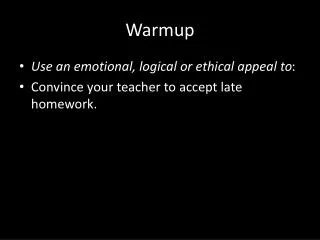
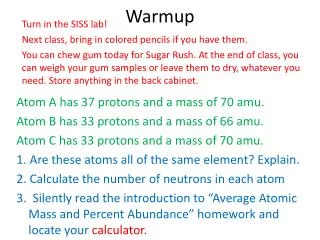
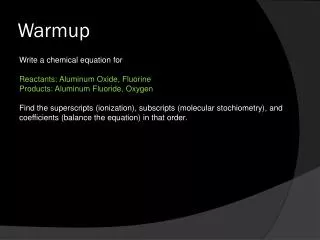
Warmup Write a chemical equation for Reactants: Aluminum Oxide, Fluorine Products: Aluminum Fluoride, Oxygen Find the superscripts (ionization), subscripts (molecular stochiometry), and coefficients (balance the equation) in that order.
OCTOBER 20TH, 2010 Covalent BondsMetallic, Ionic, & Molecular Compounds
Review: Balancing Equations Superscripts: Identify the ionization of each atom. 2) Subscripts: Use the criss-cross method, least common multiple method, or the Lewis Dot Diagram method to find the stochiometry of the molecules. Coefficients: Multiply molecules by coefficients that make the left and right side of the equation equal. Do this systematically, atom type by atom type.
Electronegativity Review • Non-polar covalent x<.5 (shares equally) • Polar covalent .5<x<1.5 (shares unequally) • Ionic x>1.5 (give-take relationship)
Metallic, Ionic, Molecular Compounds Crystalline and Metallic Structures p. 197 p. 202