Download
1 / 24
240 likes | 358 Vues
This document details the germination testing methodologies employed by Christoph Germeier and team from 2007 to 2009, including the processes for Fusarium counting and results analysis. It outlines specific germination methods used, like the ISTA methodology, the use of gibberellic acid for breaking dormancy, and variations in testing conditions. Key findings from the tests, including germination success rates and issues impacting germination like excess water, are discussed. This summary encapsulates the essential steps and outcomes of the germination tests conducted in various environments.

E N D
Workpackage 02 Germination testing Christoph Germeier, Zofia Bulinska – Radomska, Izabela Borowska, Audrey Didier
Germination methodology • Germination and Fusarium counting methodology • Germination test results 2008 • Germination methodology check test • Germination test results 2009 • germination test: how many accessions are being tested, when the tests have been started, how long do they all take?
Germination methodology General outline of germination tests according to ISTA methodology: Between paper in climate chamber, Continuous light 20°C, 4 replications (recommended 8) a 50 seeds Breaking dormancy with gibberellic acid: GA3 (1000 mg/l) in phosphate buffer (1.7799 g Na2HPO4 x 2 H20 + 1.3799 g NaH2PO4 x H2O + 1 l aqua dest.) Count after 5 and 10 days Variants used in the project FRA 2007 / 2008: Round filter paper (diameter: 90mm) are moistened with gibberellin solution and placed in the petri plate then seeds are laid down onto the filter paper. A second moistened round filter paper is disposed on the top. POL 2007 / 2008: Filter paper envelopes (CHEMPUR, 65g/m2, 12,5x18,5 cm) are moistened with gibberellin solution. Seeds are placed into the envelope, incubated at 200C with continuous light.
Germination methodology: Radzików Mold Normal germ
Germination methodology: Radzików Fusarium Normal germ
DEU 2007 / 2008: Filter paper towels (e.g. Munktell C160, 15x60cm2) are pre-folded and moistened with gibberellin solution. Seeds are placed onto the fold, the towel then folded, rolled, stabilized in a plastic bag and incubated at 200C with continuous light. 2007: climate cabinet side of plastic bag open 2008: climate chamber top of plastic bag open
Germination methodology: Quedlinburg Set up of germination tests in climate chamber (2008)
Germination and Fusarium counting methodology: Quedlinburg • A) Abnormal germ and Molds
Germination and Fusarium counting methodology: Quedlinburg • B) Fusarium more or less thick mycelium, reddish color, plants affected or not germinated
Germination and Fusarium counting methodology: Quedlinburg • B) Fusarium more or less mycelium, reddish colour, plants not affected
Germination and Fusarium counting methodology: Quedlinburg • B) Fusarium mainly reddish color, mycelium, symptoms not detectable
Germination methodology check test (marginally cultivated species)
Germination methodology check test (cultivated oat) • Germination methodology check test
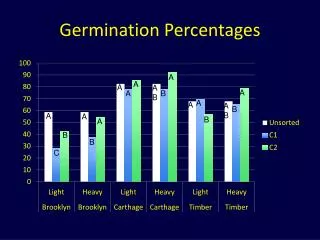
Germination check results compared with germination test 2007/2008
Germination check results compared with germination test 2007/2008
Conclusion Main problem reducing germinability: Excess of water!