Effective Lockout/Tagout Procedures for Hazardous Energy Control
This guide outlines essential Lockout/Tagout procedures to ensure safety during servicing and maintenance of machinery and equipment. It emphasizes the importance of preparing for lockout, shutting down equipment using standard procedures, isolating energy sources, and applying lockout/tagout devices correctly. Key steps include notifying employees, utilizing appropriate energy isolating devices, relieving stored energy, and verifying de-energization before work begins. Following these procedures can prevent unexpected energization and enhance workplace safety.

Effective Lockout/Tagout Procedures for Hazardous Energy Control
E N D
Presentation Transcript
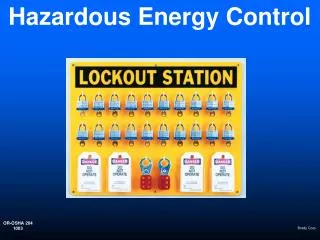
Hazardous Energy Control OR-OSHA 204 1003 Brady Corp.
Procedures must be followed when... • ...servicing and/or maintenance when unexpected energization/start-up or release of stored energy could cause injury.
Servicing and/or maintenance of machinery and equipment can include: • Adjusting • Inspecting • Modifying • Replacing parts • Tool changes • Removing jams • Lubricating • Cleaning
Procedures Step 1 - Prepare for Lockout • Review the following: • Types and magnitudes of energy • Hazards posed by that energy • Methods to effectively control the energy
Procedures Step 1 - Prepare for Lockout Prior to shutdown, all affected employees must be notified to clear their work area and/or any other area that might be hazardous.
Procedures Step 2 - Shutdown Machinery and equipment that is capable of being locked out should be shut down in an orderly manner using normal shutdown procedures.
Procedures Step 3 - Isolation All energy isolating devices should be located and operated to completely de-energize and isolate the equipment. An energy isolating device physically prevents the transmission or release of energy.
Procedures Step 4 - Lockout & Tagout Application • Machinery or equipment is “capable of being locked out” if: • it has a hasp or other means to attach a lock Brady Corp.
Procedures Step 4 - Lockout & Tagout Application • Machinery or equipment is “capable of being locked out” if: • it has a built-in locking mechanism • does not have to be dismantled or altered to achieve lockout
Procedures Step 4 - Lockout & Tagout Application Each lockout/tagout device must be singularly identified as being used only for lockout/tagout.
Procedures Step 4 - Lockout & Tagout Application Lockout/tagout devices must identify the user. Idesco Corp.
Procedures Step 4 - Lockout & Tagout Application Tagout devices must be substantial enough to prevent inadvertent or accidental removal Brady Corp.
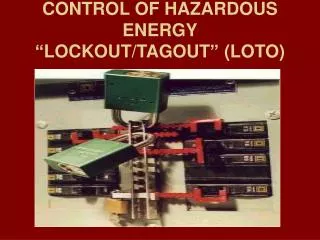
What are some examples of lockout devices? • Padlocks • Ball valve lockouts • Fuse lockouts • Plug lockouts • Lockout hasps • C/B lockouts • Gate valve lockouts Brady Corp.
Procedures Step 5 - Stored Energy Brady Corp. Immediately after applying lockout or tagout devices, the authorized employee must ensure all potentially hazardous stored or residual energy is • relieved • disconnected • restrained • otherwise safe
Procedures Step 6 - Verify Before starting work on a machine or equipment that is locked or tagged out, the authorized employee must verify that the machinery or equipment is actually isolated and de-energized.
Remember You work under your lock only! Only the authorized employee who applied the lockout/tagout device may remove that device ACT WorkCover