Download
1 / 10
100 likes | 221 Vues
This overview outlines the calibration requirements for the James Webb Space Telescope (JWST), focusing on its instruments such as NIRCam and MIRI. Key calibration goals include cross-instrument calibration, tight links to Hubble Space Telescope (HST) calibration, and ground-space observation alignment. The necessary ground-based standards span a range of wavelengths (0.6-27 microns) and spectral resolutions. Key wishes for calibration emphasize the need for accurate photometric and astrometric standards, all-sky coverage, and the adaptation of ground-based instruments to meet JWST's advanced calibration needs.

E N D
JWST calibration requirements Harald Kuntschner
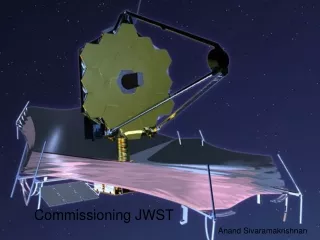
JWST - an overview • NIRCam • 0.6-5 microns • FoV: 2.16x4.4 arcmin (0.0317” for short band and 0.0648” for long band) • NIRSpec (MOS) • ~0.8-5 microns • R=100, 1000 & 3000; FoV: 3.2x3.4 arcmin; slit width: 200mas
JWST cont. • MIRI • 5-27 microns • Imager: FoV 1.3x1.3 arcmin; R=100 spec. from 5-10 micron • IFU Spectroscopy: 3”x3” - 7”x7” with 0.2” sampling; R=3000
JWST sensitivity 5m
Main calibration goals • Very good cross-instrument calibration on JWST (astrometric, spec, phot and wavelength) • Tight link to HST calibration (and other space instruments) • Tight link between ground and space based observations
Calibration needs (or wishes!) • Ground based photometric standard stars from 0.6-27 microns (matching closely the on board instrument filters, and FoV of NIRCam, MIRI) • Ground based spectrophotometric standard stars with well know flux from 0.6-27 micron; matching the resolutions up to R=3000; Key requirement: model atmospheres • Ground based, accurate astrometric fields suitable to FoV and spatial resolution • Astronomical wavelength standards … For all of the above we need appropriate magnitude range
Calibration wishes cont. • Need good all sky coverage (need northern partner observatory!) since it is expensive to move JWST. Long duration (~100,000.0 sec) programs on one location foreseen. • ESO can offer: • ISAAC, VISTA, VISIR, CRIRES (,FORSes)
NIRSpec shutters • We expect complicated spectral behavior • Need very good calibrators up to R=1000 • Target acquisition demands high astrometric accuracy.
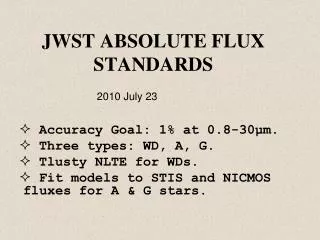
Specphot stars Optical/NIR paper: Bohlin et al. (2001) EG131 Need smooth specphot stds and model atmospheres! ABmag~=8-12 “typical” flux std
Conclusions • JWST demands will drive some of the ground based instruments to the limit. • Can we modify and expand ESO instrument calibration programs such as to provide JWST with a calibration basis?