Download
1 / 10
100 likes | 221 Vues
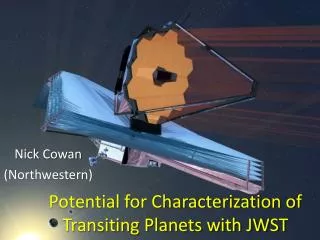
The James Webb Space Telescope (JWST) is at the forefront of astronomical research, progressing through final testing stages of its hardware, including the full-scale sunshield and mirror. Designed to observe the earliest galaxies, this advanced instrument will provide razor-sharp images and vital insights into cosmic phenomena such as reionization, galaxy evolution, and the formation of Pop III star clusters. Additionally, JWST will enhance our understanding of extrasolar planets, including the detection of life-bearing conditions through spectroscopy and photometry of transiting exoplanets.

E N D
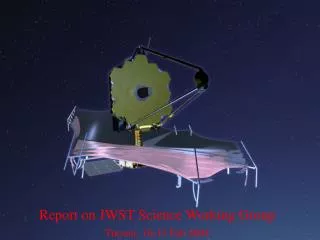
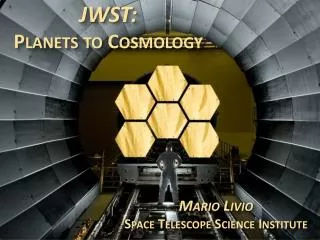
JWST:Planets to Cosmology Mario LivioSpace Telescope Science Institute
The James Webb Space Telescope Hardware progressing: Sunshield full-scale membrane The JWST sunshield - full scale membrane Log scale: 2.0” x 2.0” Linear scale: 2.0” x 2.0”
JWST will see the very first galaxies Hubble UDF Simulated JWST
Razor sharp vision of early universe 1’x1’ region in the UDF – 3.5 to 5.8 μm Implications for: Pop III star clusters?, reionization, cosmic star formation history, structure formation, galaxy evolution Spitzer, 90,000s per band(GOODS collaboration) JWST, 1000s per band(simulated)
The James Webb Space Telescope Extrasolar planets:habitable zone JWST will see planets around other stars
JWST: spectroscopy and photometry of transiting exoplanets Temperature-pressure profiles, molecular species, moons