
SlideServe
Menu
Préférences
© SlideServe · v2026

Operant Conditioning Concepts

odin avatar
15 diapositives · 495 Views · Jun 28, 2012

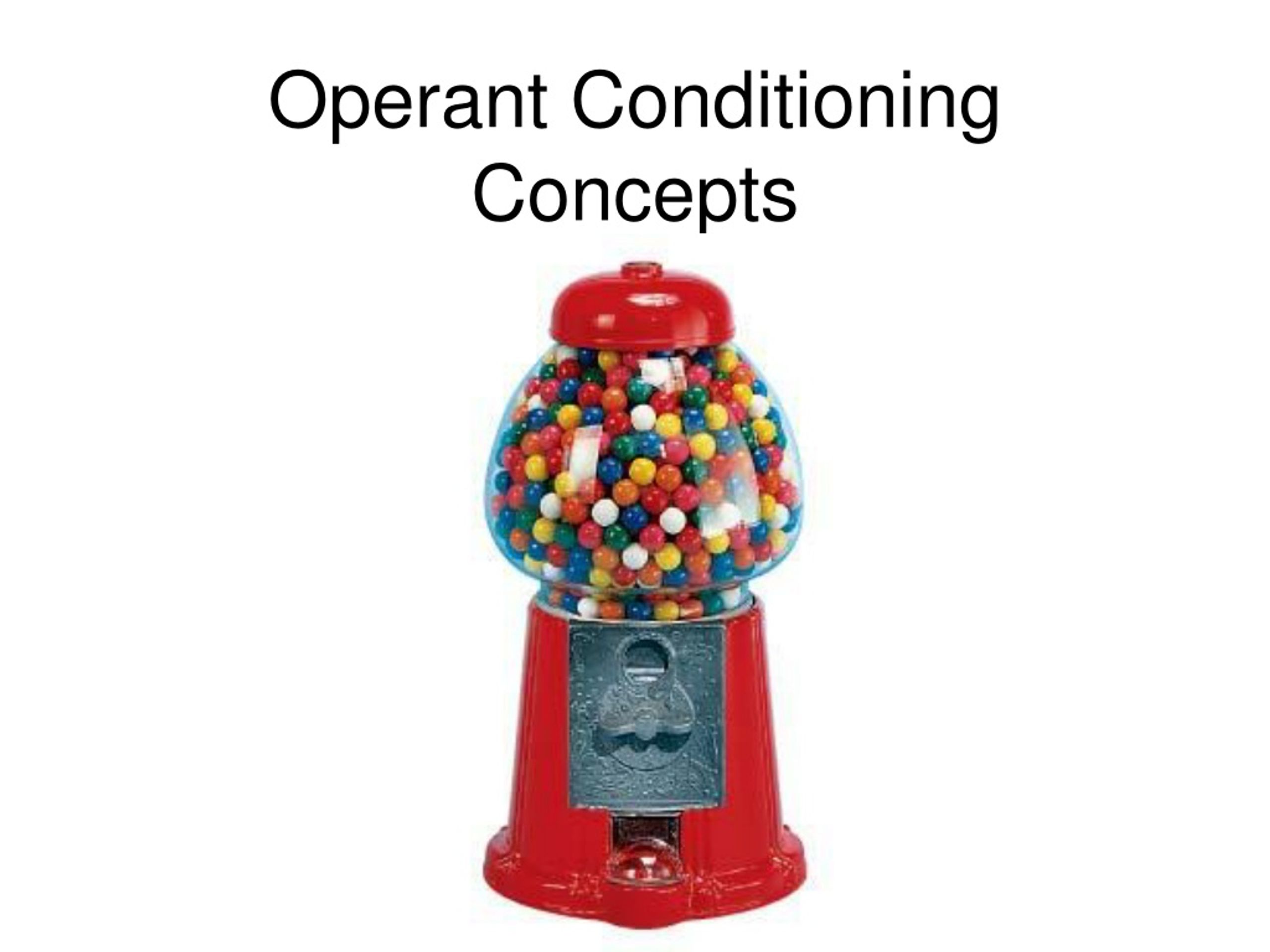
Operant Conditioning Concepts. What is the gumball that you receive from the machine called? Positive Reinforcement. You go back to the gumball machine several times and it is empty each time. Why will you eventually quit going? Extinction.
Operant Conditioning Concepts - slide 1
01 / 15Operant Conditioning Concepts
1 / 17

Télécharger la présentation

Operant Conditioning Concepts
Une image / un lien ci-dessous est fourni (tel quel) pour télécharger la présentation

Politique de téléchargement : le contenu du site vous est fourni TEL QUEL pour votre information et votre usage personnel ; il ne peut être vendu, concédé sous licence ni partagé sur d’autres sites sans l’accord de son auteur.Le contenu vous est fourni TEL QUEL, pour votre information et votre usage personnel uniquement. Téléchargez la présentation en cliquant sur ce lien. Lors du téléchargement, si vous ne parvenez pas à télécharger une présentation, l’éditeur a peut-être supprimé le fichier de son serveur.Pendant le téléchargement, si vous ne parvenez pas à obtenir une présentation, le fichier a peut-être été supprimé par l’éditeur.

F I N

Plus de contenu associé

Transcription de la présentation
  1. Operant Conditioning Concepts

  2. What is the gumball that you receive from the machine called? • Positive Reinforcement

  3. You go back to the gumball machine several times and it is empty each time. Why will you eventually quit going? • Extinction

  4. What would you call your behavior if the dispenser was refilled and you bought a gumball again. • Spontaneous recovery

  5. Why would you be able to operate this particular gumball dispenser, even if you had never seen this exact dispenser before? • generalization

  6. Why would you choose to work a full dispenser instead of an empty one? (ok, I know it seems obvious, but what is the psychological term ) • discrimination Vs.

  7. What would be happening if you put the quarter in the dispenser, but didn’t get your gumball until an hour later? • Delayed reinforcement • Is this effective? No.

  8. Every second time you turn the dial on the gumball machine you get a gumball. In other words, you know that two turns of the dial= receipt of a gumball. This is called: • Fixed-ratio schedule.It always occurs at the same rate. Produces strong learning, but learning extinguishes quickly after the reinforcement schedule goes away.

  9. If you didn’t get a gumball every time you put money in, and instead sometimes got the gum after three tries, some times after eight, and it was very unpredictable this would be: • Variable ratio schedule. Takes longer to condition a response, but learning is resistant to extinction. (Slot machines are a good example)

  10. You walk by the gumball machine at 10:00 one morning and it says “Free Gumballs”. You walk by at 2:00 and the sign is gone, but the next morning at 10:00 the “Free” sign is back. This is an example of • Fixed interval schedule.

  11. You pass by the gumball machine every day, and the “Free” sign is always random. You never know when it is going to be there. This is • Variable interval schedule. (Good example would be a teacher who gives “pop quizzes”.

  12. You give up. You feel like you will never get a gumball and quit trying. This is called • Learned helplessness.

  13. Reinforcement STRENGTHENS a behavior. What is the difference between a positive reinforcer and a negative reinforcer. • Positive reinforcer ______ a pleasurable stimulus or reward after a desired behavior. • Negative reinforcer _______ an undesirable stimulus.

  14. So… which is positive, which is negative? • Your coach says “well done” after you make a big play. • You take an aspirin to get rid of a headache. • You hurry home in the winter to get out of the cold. • Your mom lets you stay out a ½ hour later because you received all A’s. • Saying “uncle” to stop your older brother from wrestling with you. • Faking a headache to get out of practice.

  15. In contrast, punishment REMOVES a behavior by giving an unwanted consequence • Because the consequence is unwanted, the fear of this decreased the behavior. • Example: getting a spanking when you try to cross the street without looking. • Positive punishment: addition of something unpleasant. Ex: giving a speeding ticket. • Negative punishment: taking something desirable away… “omission”. • Problem with physical and/or positive punishment: does not teach correct behavior all of the time. For this “omission” is more effective… (Example: time out in daycare, “when you learn the correct attitude you can come back and play”).