Observing Earth-Mass Planets in the Habitable Zone of M Dwarfs Using Near-Infrared Techniques
130 likes | 269 Vues
This paper discusses the advantages of observing mid- to late-M dwarf stars in the near-infrared (NIR) to detect Earth-mass planets in their habitable zones. Due to current technical limits, radial velocity measurements of these planets require the higher sensitivity offered by NIR observations. Our analysis demonstrates that NIR spectroscopy significantly enhances Doppler information, leading to improved radial velocity precision. We also address technical challenges in NIR observations, including telluric contamination and the need for high-resolution wavelength calibration.


Observing Earth-Mass Planets in the Habitable Zone of M Dwarfs Using Near-Infrared Techniques
E N D
Presentation Transcript
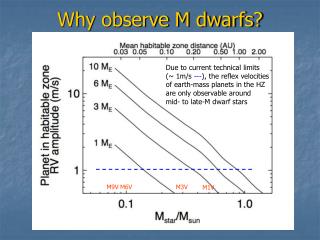
Why observe M dwarfs? Due to current technical limits (~ 1m/s ---), the reflex velocities of earth-mass planets in the HZ are only observable around mid- to late-M dwarf stars M6V M9V M3V M1V
Why observe in the near-IR? GL 406 M6V (IRTF/SpeX R~2000) Radial velocity precision, v = c Q-1 Ne-0.5 Bouchy et al. (2001) Although M dwarfs are much brighter in the NIR than the optical (more photo- electrons Ne), simulations for vmust include the measurable amount of Doppler Information (Q) in optical and NIR spectra PRVS Y+J+H
Simulations: Q,v vs v sini (8 m) R=70,000 S/N=300 M3V M6V R=70,000 S/N=300 M9V R=70,000 S/N=300
Theory/Obs Comparison • From high R data, M dwarf theoretical models (Peter Hauschildt) underestimate the Doppler Information (Q) in the NIR by factors > 2 • Considering models + data there is a clear advantage to observing mid- late-M dwarfs in NIR (Y+J+H bands, photon-limited) over the optical GL 406 (Wolf 359) M6V J-band, R=20,000 Keck/NIRSPEC (McLean et al. 2007) Qmodel ~ 800 Qdata ~ 1600
What is the intrinsic RV jitter of M dwarfs? Keck optical sample, Wright et al. (2005) • Causes of intrinsic jitter • Rotation + star spots/surface features • Activity/variability • Turbulence and pulsation • Results from optical RV surveys • For non-active M dwarfs, average intrinsic jitter ~ 4 m/s • No significant trend with SpT • Expectations for NIR RV surveys • Higher v sin i for late-M dwarfs • But 2 x better star spot contrast in NIR means intrinsic jitter likely < 4 m/s for non-active M dwarfs F stars G & K stars M stars
Technical challenges of RV in the NIR • Simultaneous wavelength fiducial covering NIR is required for high precision RV spectroscopy • No suitable gas/gases for a NIR absorption cell found • Use simultaneously exposed arcs (Th-Ar, Kr, Ne, Xe) and ultra-stable spectrograph • ~ 300 bright lines to monitor drift during observing (using super exposures and sub-array reads of arc lines) • ~ 1000 lines for PSF and wavelength calibration (daytime) • Use of a laser comb possible following R&D • Significant telluric contamination in the NIR • Mask out 30 km/s around telluric features deeper than 2% • At R=70,000 (14,000 ft, 2 mm PWV, 1.2 air-mass) this leaves 87% of Y, 34% of J, and 58% of H • Simulations indicate resulting ‘telluric jitter’ ~ 0.5 m/s • PRVS ‘Pathfinder’ instrument being used at Penn State supports this modeling (see Pathfinder poster below)
Realistic PRVS Simulations M6V Teff = 2800 K Log g = 5 v sin i = 0 km/s Model Telluric OH
Fourier Analysis FT (f/) F() • Doppler info of spectrum • F() related to f/. • FT (f/) = k f(k) where • spatial freq k = 2/ • Plot k f(k) vs k for M6V • and v sin i = 0 km/s • Over-plot FT (Gaussian PSF) • for R=20k, 50k, 70k, 100k • RESULT: • optimum R 70,000 V Y R=70,000 J H K
PRVS SENSITIVITY NICHE S/N break-even point between optical and NIR surveys is early- to mid-M SpT OPTICAL RV (8 m) PRVS NIR RV Mean intrinsic RV jitter ~ 4 m/s measured in optical Improved intrinsic RV jitter in NIR? M9V M6V G2V M3V M1V
Habitable zone is more accessible around M dwarfswhen observed in the NIR 1.0 m/s 0.1 m/s Required RV precision to detect 1 ME Kasting et al. (1995) M Star Planet Habitability: Special issue of Astrobiology (February 2007), including review by Tarter et al.