Download
1 / 5
50 likes | 143 Vues
Explore the medieval learning principles of Summa Theologiae and the Watchmaker Argument by William Paley, reflecting on reason and existence of God. Understand the structure, proofs, and interpretations in a thought-provoking journey.

E N D
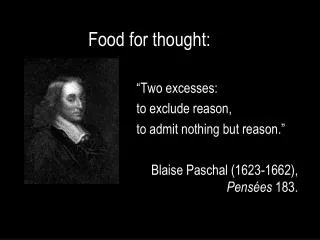
Food for thought: “Two excesses: to exclude reason, to admit nothing but reason.” Blaise Paschal (1623-1662), Pensées 183.
St. Thomas Aquinas Medieval Learning Summa Theologiae Five proofs of the existence of God.
Medieval learning • Lectio. • Reading of a set of texts. • Interpretation of the text by a professor. • Disputatio. • Thesis • Objections • Determination
The structure of the articles in the Summa 1. Statement of the question. 2. Objections (arguments on one side). 3. Statement from authority. 4. Aquinas’ response (arguments on the other side). 5. Reply to each objection.
Watchmaker Argument William Paley (1743-1805)