Selecting Recording Devices: Key Considerations for Performance, Scalability, and Cost
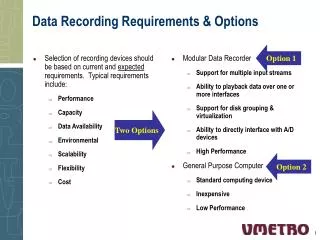
When selecting recording devices, it's vital to consider current and anticipated requirements. Key factors include performance, capacity, availability, environmental conditions, scalability, flexibility, cost, and modularity. Opt for devices that support multiple input streams, playback functionalities, disk grouping, and virtualization. High-performance general-purpose computers can handle various sensor input streams, although they may face bandwidth limitations. In contrast, dedicated data recorders typically offer superior sustained bandwidths, making them ideal for high-demand applications.

Selecting Recording Devices: Key Considerations for Performance, Scalability, and Cost
E N D
Presentation Transcript
Selection of recording devices should be based on current and expected requirements. Typical requirements include: Performance Capacity Data Availability Environmental Scalability Flexibility Cost Modular Data Recorder Support for multiple input streams Ability to playback data over one or more interfaces Support for disk grouping & virtualization Ability to directly interface with A/D devices High Performance General Purpose Computer Standard computing device Inexpensive Low Performance Data Recording Requirements & Options Option 1 Two Options Option 2
General Purpose Computer or Data Recorder? Sensors feed into a PC where it will be carried to the drive controller via the PCI bus Industrial PC Sensor Multiple sensors can be supported but the controller quickly becomes a bottleneck SCSI JBOD 2 JBOD 1 General Purpose Computers may provide bandwidths from 12MB/s to 50MB/s
Multiple sensor feeds X500MEZZ FPDP GPS FPDP VME Chassis Sensors FC CPMDR Fibre Channel FC AL 1 JBOD 1 JBOD 2 FC AL 2 Host Data is striped across each Disk, and across each JBOD General Purpose Computer or Data Recorder? Typically Data Recorders provide SUSTAINED bandwidths from 80MB/s to 360MB/s