General observations
This comprehensive analysis examines various modeling approaches tailored to specific questions about Latin America, focusing on demographic trends, energy consumption, and emissions scenarios up to 2025. It highlights the potential for formal comparisons across different models and incorporates new data on population growth, labor productivity, and economic development. Key issues include land-use efficiency, climate feedbacks, and international trade implications, emphasizing the importance of global coordination in policy implementation. The study aims to identify priority areas for further investigation and enhance consistency between regional and global modelers.

General observations
E N D
Presentation Transcript
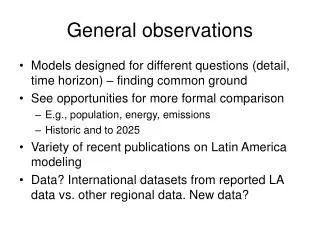
General observations • Models designed for different questions (detail, time horizon) – finding common ground • See opportunities for more formal comparison • E.g., population, energy, emissions • Historic and to 2025 • Variety of recent publications on Latin America modeling • Data? International datasets from reported LA data vs. other regional data. New data?
Demographics – population growth (stabilization by 2030/40), labor force, education, households, labor productivity, urban & rural (definition?), income distribution Informal economy Interior (vs. coastal) development trends Accelerated technological evolution Economic development scenarios Decrease importance of investments Incorporate remittances to economy models Include natural resource price cycles Review life style and technology issues (e.g., air transportation, nuclear, hydropower potential) Expect greater importance of nuclear, hydropower, and natural gas Development and increases in emissions – access to services (electricity, water, waste disposal) and impact on emissions (e.g., increased use of landfills and increase in ch4 emissions) Land-use – ag and livestock growth expected, potential to improve efficiency (per unit land), biomass ethanol land area required given current technology, challenging to model deforestation Importance of international trade Little biomass electricity Climate feedbacks Sensitivities important Some issues raised by Latin American experts
Global modelers • What did you see thus far? • Priority areas for review/revision? • Areas for further investigation? • Key areas of consistency between global and regional expert modeling?
Reference Population growth Labor productivity Energy Supply alternatives set over time What’s in? Marginal costs of extraction over time? Supply transformation – e.g., liquefied coal, methane capture for natural gas based energy End-use – efficiency and transformation (e.g., alternative fuel transportation) Growth in emissions per capita Land use modeling – deforestation, land-use drivers Uptake – ocean and terrestrial Mitigation Energy Speed of adjustment of energy demand and energy supplies Biomass technologies (input material and conversion), land requirements and constraints Efficiency endogeneity CCS penetration (esp. acceptable storage availability) Policy implementation (anything less than global coordination) Trade implications Some key structural assumptions
Global primary energy consumption (EJ) Reference Source: CCSP 2.1A
Global primary energy consumption (EJ) Reference Flat or declining energy consumption? A low/zero carbon energy future? 3.4 W/m2 Source: CCSP 2.1A
Global primary energy consumption (EJ) Reference 6.7 W/m2 3.4 W/m2 Source: CCSP 2.1A
1% loss = $ 3 – 3.5 trillion Global GDP (GWP) 2050 GDP losses Source: IPCC WGIII AR4 Source: CCSP 2.1A
Global primary energy consumption (EJ) Reference 6.7 W/m2 Source: CCSP 2.1A