Understanding Even and Odd Functions: Classification and Analysis
This guide focuses on identifying even and odd functions through graphical and algebraic methods. It covers essential concepts such as function behavior—where the function increases, decreases, or remains constant—and the identification of relative maximums and minimums. Examples include classifying functions based on symmetry with respect to the y-axis, origin, or neither. Additionally, algebraic tests for evenness (F(-x) = F(x)) and oddness (F(-x) = -F(x)) are explored, alongside graphical techniques for verification.

Understanding Even and Odd Functions: Classification and Analysis
E N D
Presentation Transcript
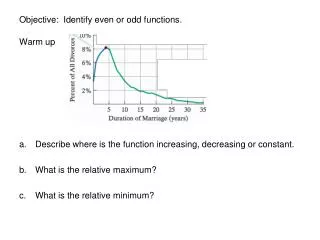
Objective: Identify even or odd functions. Warm up • Describe where is the function increasing, decreasing or constant. • What is the relative maximum? • What is the relative minimum?
Example 1Classify each function as symmetric w.r.t. y-axis, origin or neither.
Identifying even or odd functions • Graphically (look for symmetry) symmetric w.r.t y-axis: even symmetric w.r.t origin (rotational symmetry): odd • Algebraically If F(- x) = F(x), then is even. If F(- x) = - F(x), then is odd. Example 2 Graph the function. Find the symmetry and decide if the function is even or odd. Confirm algebraically. a. b. c.