Download
1 / 14
140 likes | 251 Vues
This study presents a robust methodology for estimating mean contamination in environments requiring cleanup, particularly where contamination follows a mixed and skewed distribution. By employing bootstrap techniques and the Probability Plot Correlation Coefficient (PPCC) approach, we aim to enhance the accuracy of estimates in the presence of values below the quantization limit. Our results demonstrate that the PPCC p-value test achieves a significant level close to desired outcomes, proving to be more resilient to variations in contamination coefficients than traditional maximum tests. Future work will explore alternative contamination distributions.

E N D
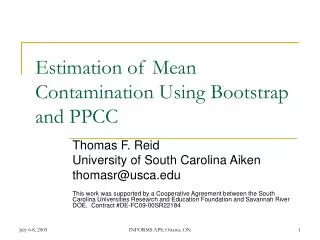
Estimation of Mean Contamination Using Bootstrap and PPCC Thomas F. Reid University of South Carolina Aiken thomasr@usca.edu This work was supported by a Cooperative Agreement between the South Carolina Universities Research and Education Foundation and Savannah River DOE. Contract #DE-FC09-00SR22184 INFORMS APS, Ottawa, ON
Introduction • Cleanup sites need to be proven “safe” • Contaminated and uncontaminated regions • Mixed distribution, skewed to the right • Use of “composite testing” to reduce expense • C “raw” samples per composite sample • N composite samples • Problem: • due to skewness, standard small sample techniques do not perform well INFORMS APS, Ottawa, ON
Proportion of site that is uncontaminated: p Contaminated portion follows a Gamma distribution Unable to detect values below the quantization limit (QL) All values below QL are recorded as QL/2 p=0.5,μ=1,CV=2 0.8 0.6 0.4 0.2 x 0.5 1 1.5 2 2.5 3 Mixed Contamination Distribution INFORMS APS, Ottawa, ON
Max Test • Recommended by EPA Soil Screening Guidance for Radionuclides • Site is “safe” if max observed value of composite samples is less than 2 times the (conservative) “soil screening level” • Using simulation results, selected N and C so that the desired significance level is achieved (approximately) INFORMS APS, Ottawa, ON
Probability Plot Correlation Coefficient (PPCC) • Use Gamma to approximate the continuous portion of the sample distribution (i.e., contamination) • Let nlow denote the number of observations below the QL. For nc=0,1,…,nlow: • find shape (α) that maximizes the PPCC for fixed scale (β=1) when nc of the low readings are assumed to be from the contaminated distribution • choose nc that gives maximum PPCC • Jointly estimate p, shape, and scale INFORMS APS, Ottawa, ON
PPCC Illustration INFORMS APS, Ottawa, ON
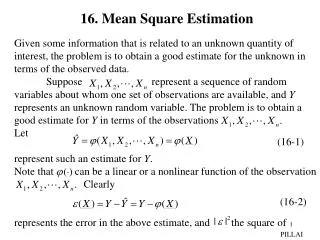
Estimating Mean Contamination • Possible Estimators • Sample Mean ( ) • Approx. PPCC Estimator:p(QL/2) + (1-p)(αβ)where p, α, and β are all estimated using PPCC • Mixed Estimatorp(QL/2) + (1-p)( ) INFORMS APS, Ottawa, ON
CI Estimation – Not Promising! INFORMS APS, Ottawa, ON
PPCC p-Value Test • Test of hypothesis approach • Use PPCC to estimate p and shape • Choose scale to get a mean for the mixed distribution of μ0 • Parametric bootstrap using estimated parameters • Empirical p-value: proportion of bootstrap replications with sample mean less than the observed sample mean • Reject H0 if p-value less than significance level (i.e., conclude site is “safe”) INFORMS APS, Ottawa, ON
Approximate p-value from Bootstrap INFORMS APS, Ottawa, ON
Empirical p-value Performance INFORMS APS, Ottawa, ON
Empirical p-value Performance (μ = 1, nominal significance=0.05) INFORMS APS, Ottawa, ON
Power Comparison with Max Test INFORMS APS, Ottawa, ON
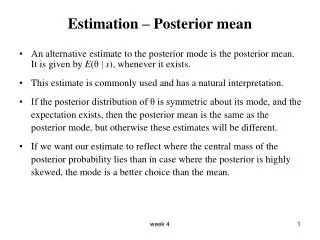
Conclusions • PPCC p-Value Test • Achieved significance level is close to “desired” • Appears to be more robust to changing CV than the Max Test • Can be used with any sample size, not just those specified by EPA SSG • Future Research • Contamination distributions other than Gamma • Impact of measurement error on performance INFORMS APS, Ottawa, ON