Advanced Control for AC Dipole Tasks: Hardware and Software Approach
This project focuses on developing hardware and software solutions for AC dipole tasks in accelerator physics. The hardware design includes a resonant pulsed kicker and 20 kW power amplifier, while the software application aids in linear optics measurements and corrections. The project also explores a high-Q magnet with tunable circuitry for future developments. Additional AC dipoles are needed, with specific magnet specifications for field amplitude and frequency range. The project aims to improve optics measurements through analysis of RHIC data and integration of novel tuning techniques.

Advanced Control for AC Dipole Tasks: Hardware and Software Approach
E N D
Presentation Transcript
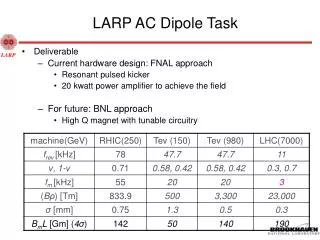
LARP AC Dipole Task • Deliverable • Current hardware design: FNAL approach • Resonant pulsed kicker • 20 kwatt power amplifier to achieve the field • For future: BNL approach • High Q magnet with tunable circuitry
LARP AC Dipole Task • Deliverable • Software • AC dipole control application • FNAL • Accelerator physics application • linear optics measurements/corrections • Non-linear resonance driving term
RHIC AC Dipole Status • Requires two more ac dipoles@Qacd=0.5 • Magnet specs: • Amplitude of the field: 100 Gauss-m • Frequency range: +-390Hz@39kHz • Explore the switched capacitor technique for continuous tuning (P. Oddo(BNL)) Binary switched capacitor scheme Peter is testing single capacitor scheme for which a biased voltage is applied to the capacitor to adjust the capacitance
Linear optics measurement and corrections • Analyze the RHIC 2007 optics data • Dedicate optics data sets taken with single quadrupole error. • Currently, the RHIC beta function and phase advance measurements by ac dipole are calculated by fitting the 1024 turns of TBT data with
Plan for AP • Re-analyze the RHIC 2007 optics data • Need to add the term of (1-Qacd) to the fitting to take into account the effect of the driven oscillation at (1-Qacd) which can be significant when betatron tune gets closer to 0.5 according to R. Miyamoto(FNAL)
δ ν νd 1-νd 0 1 From R. Miyamoto (FNAL) Analytic Expression of the Driven Oscillation
From R. Miyamoto (FNAL) Measuredβ For RHIC and LHC, the effect can be as large as 6%