How to Effectively Use a Multimeter: A Beginner's Guide
Learn how to use multimeters safely and effectively, whether you have a black or yellow model. Start by connecting one wire to the ‘COM’ terminal. To measure current, insert a second wire into the ‘10A’ terminal and set the dial to 10A; remember to connect it in series to avoid short circuits. For voltage measurement, use the ‘V’ terminal and set the dial to 20V, ensuring it's connected in parallel. Always turn the dial off after use to save battery power. Proper technique ensures accurate readings and equipment longevity.


How to Effectively Use a Multimeter: A Beginner's Guide
E N D
Presentation Transcript
Multimeters How to use them
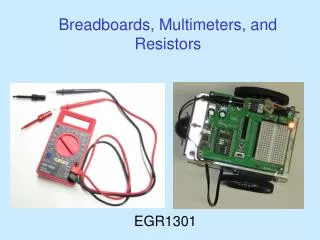
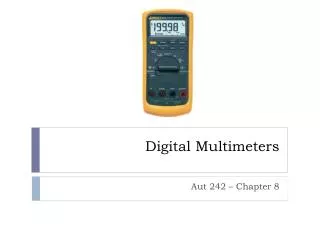
The Multimeter We have black and yellow ones – the black ones are the ‘newest’… Some of the yellow ones have ‘use only as an ammeter’ written on them… look at such advice!
‘COM’ • Always start by putting a wire into the ‘com’ connection – this is common to its use as a voltmeter and ammeter.
Use as an ammeter • You already have one wire in the ‘com’. You need to put another wire in the terminal with ’10A’ on it • Then turn the dial to 10A
Ammeter • The ammeter is placed in series in a circuit – never put it in parallel – it is of such low resistance that it will cause a short circuit and could make your power pack ‘blow’ or a battery get very hot! • You have to make a gap in your circuit to add it in. Put it next to the component you wish to investigate. • It tells you the rate at which the charge is moving through your component (how fast the charge is moving) • A ‘typical’ low current is 0.1A • A high current is anything more than 1A – 5A will make the wires smell and/or melt!
Use as a voltmeter • You already have one wire in the ‘com’. You need to put another wire in the terminal with a V on it • Then turn the dial to 20V
Voltmeter • The voltmeter is placed in parallel around the component you are investigating. Never put it in series – it has such a high resistance it will cut the flow of current down to a trickle! • It tells you the potential difference across the component – the ‘electrical slope’ that makes charge move through it. • It is always the last part of a circuit that you wire up and can be added or removed without changing the action of the circuit itself.
Always turn the dial ‘off’ after use • These multimeters operate on 9V batteries. • They are expensive to run all day and night! • Make sure they are ‘off’ when you are not using them