Balancing Ecology and Economy in Forest Conservation and Plant Evolution Insights
This chapter outlines the intricate balance within forest conservation, considering the interplay between ecological needs and human economic demands. It discusses the terrestrial nature of plants and how algae evolved to adapt to land challenges. The four stages of plant evolution, from bryophytes to flowering plants, are examined, alongside the significance of the Carboniferous period in providing resources like coal. The adaptations of gymnosperms to harsh climates, the definition of seeds as life support systems, and the advancements of angiosperms highlight the importance of preserving plant diversity for ecological, economic, and medicinal reasons.

Balancing Ecology and Economy in Forest Conservation and Plant Evolution Insights
E N D
Presentation Transcript
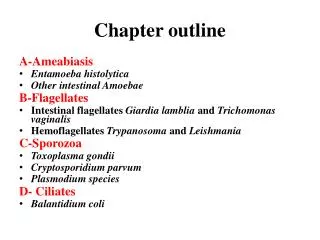
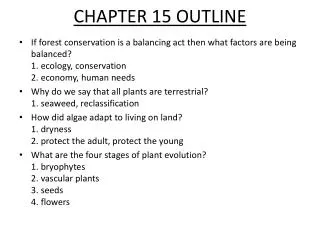
CHAPTER 15 OUTLINE • If forest conservation is a balancing act then what factors are being balanced?1. ecology, conservation2. economy, human needs • Why do we say that all plants are terrestrial?1. seaweed, reclassification • How did algae adapt to living on land?1. dryness2. protect the adult, protect the young • What are the four stages of plant evolution?1. bryophytes2. vascular plants3. seeds4. flowers
2 • Why is the Carboniferous period important to modern society?1. liquid fossils2. fuel • How did gymnosperms adapt to a colder, drier climate?1. seeds • What is a seed? 1. life support system for embryo • How are angiosperms more advanced than gymnosperms?1. flowers2. fruit3. pollinator coevolution • Why is preserving plant diversity important?1. morals and ethics2. economics3. medicine