Hydrate Dissociation and Carbon Isotope Excursion in Seawater: Insights from Multichannel Seismics
This study explores the dissociation of methane hydrates in a pure CH4 hydrate/seawater system, factoring in specific hydrostatic and geothermal gradients alongside the bottom-water temperature. The multi-channel seismic data identifies key locations such as the Blake Bahama Outer Ridge where chaotic reflections suggest methane release linked to a significant carbon isotope excursion (CIE). The interplay between biological productivity and the resulting changes in the d13C ratio of seawater elucidates how methane hydrate decomposition influences carbon cycling in marine environments.

Hydrate Dissociation and Carbon Isotope Excursion in Seawater: Insights from Multichannel Seismics
E N D
Presentation Transcript
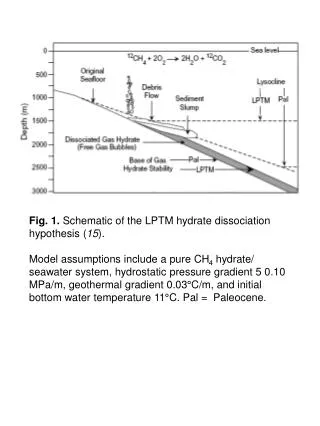
Fig. 1. Schematic of the LPTM hydrate dissociationhypothesis (15). Model assumptions include a pure CH4 hydrate/ seawater system, hydrostatic pressure gradient 5 0.10MPa/m, geothermal gradient 0.03°C/m, and initial bottom water temperature 11°C. Pal = Paleocene.
Fig. 2. Multichannel seismics line TD-5. (A) Map showing location of inset (B). BBOR, Blake Bahama Outer Ridge. (B) Enlarged location map with drill sites and seismic lines shown in (C) and (D). (C) Chaotic reflections correlated with the CIE (carbon isotope excursion) near an Aptian reef may be a CH4 release site. (D) Erosional scarp and current-controlled sedimentation associated with a reflection correlated with the CIE; reflection Ab is the equivalent age to reflection Ab mapped on the western Bermuda Rise.
12C enriched HIGH BIOLOGICAL PRODUCTIVITY PRODUCES A LOW d13C ratio IN SEAWATER High 12C input to biology: Seawater becomes depleted in 12C, SO THE d13C ratio IN THE REMAINING SEAWATER is HIGH When methane hydrates decompose, the carbon with the excess 12C now vents into seawater, lowering the d13C ratio of the seawater High 12C output to seawater: Seawater becomes rich in 12C and depleted in 13C, So the d13C ratio BECOMES LOWER 12C enriched X X