Vitamins and Minerals
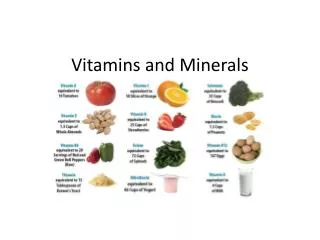
Vitamins and Minerals. Essential Nutrients Perform hundreds of roles Healthy diet is best way to obtain these nutrients Fine line between getting enough and having too much. Micronutrients – Your body only needs tiny amounts. Vitamins vs. Minerals. Vitamins – Organic, can be

Vitamins and Minerals
E N D
Presentation Transcript
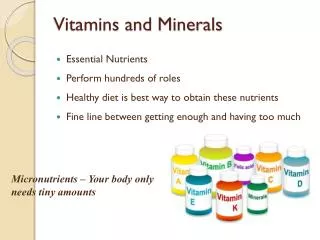
Vitamins and Minerals • Essential Nutrients • Perform hundreds of roles • Healthy diet is best way to obtain these nutrients • Fine line between getting enough and having too much Micronutrients – Your body only needs tiny amounts
Vitamins vs. Minerals Vitamins – Organic, can be broken down by heat, air, or acid Minerals – Inorganic, they retain their chemical structure Why does this matter? Minerals can easily find their way into your body through food, vitamins often are destroyed through cooking
Water-Soluble Vitamins • Absorbed directly into the bloodstream through digestion or as supplements dissolve • Kidneys regulate levels • Excess is excreted through urine
Water-Soluble Vitamins What They Do: • Releases energy in food – B Complex Vitamins • Produce energy – Thiamin, Riboflavin, Niacin, Pantothenic Acid, Biotin • Build protein and cells – B6, B12, Folate • Make collagen – Vitamin C
Deficiency of Vitamin B1 (Thiamine) Beri-Beri – • Weight loss, body weakness and pain • Inflammation of the nerves and heart failure Sources: Fortified breads and cereals, fish, lean meats and milk
Deficiency of Vitamin B3 (Niacin) Pellagra • Diarrhea, Dermatitis, Dementia, Death Sources: Red meat and whole grains
Deficiency of Vitamin C • Scurvy Sources: Citrus fruits, strawberries, potatoes, broccoli
Fat-Soluble Vitamins • Travel through the body by proteins • A, D, E, K • Excesses are stored in liver and fat tissues • Liver releases excesses as needed
Fat-Soluble Vitamins What They Do: Build Bones – Vitamin A, D, K Protect Vision – Vitamin A Promotes Absorption of Calcium – Vitamin D Protect the Body – Vitamin E Blood Clotting – Vitamin K ***Stored in your body for long periods of time; an excess amount of these vitamins can be toxic.
Deficiency of Vitamin A • Blindness
Deficiency of Vitamin D • Rickets – a weakening and softening of the bones
Vitamin E • Antioxidant- protects body from free radicals • Maintains strong immune system *Deficiencies are Very Rare Too much Vitamin E: • Bleeding in the Brain • Risk of Birth Defects
Minerals Major • Calcium • Chloride • Magnesium • Phosphorous • Potassium • Sodium • Sulfur Trace • Chromium • Copper • Fluoride • Iodine • Iron • Manganese • Selenium • Zinc
Major Minerals What They Do: • Maintain the proper balance of water in the body – Sodium, Chloride, Potassium • Important for healthy bones – Calcium, Phosphorous, Magnesium • Stabilize protein structures (Hair, Skin, Nails) – Sulfur • ***Needed in larger amounts and stored in the body
Trace Minerals What They Do: • Blood formation and function – Iron • Strengthens bones/prevents tooth decay – Fluoride • Body growth and maturation – Zinc • Bone and cartilage development, - Copper • Protects against cancer – Selenium • Formation of thyroid hormones – Iodine • Maintains blood sugar levels – Chromium • Heals wounds – Manganese ***Needed in very small amounts
Resources • http://www.helpguide.org/harvard/vitamins_and_minerals.htm • http://maxpotentialsports.com/2013/09/14/3-vitamins-minerals/ • http://www.medimanage.com/my-worries/articles/all-about-kidney-stones.aspx • http://www.genalivings.com/the-first-stabilizer-of-health-get-nutritionally-sound-the-six-major-nutrients-4-5-vitamins-and-minerals/ • http://www.theresearchpedia.com/health/health-benefits-of-foods/vitamin-a-deficiency-excess-and-vitamin-a-supplements • http://www.thachers.org/rickets_photos.htm • http://indulgy.com/post/4Zv0AswhZ1/natural-sources-of-vitamin-e-health-benefits-o • http://www.yorkvision.co.uk/news/shiver-me-timbers-scurvy-on-campus • http://listverse.com/2012/03/16/top-10-vitamin-deficiencies/ • http://healthyeating.sfgate.com/importance-trace-elements-human-body-4684.html