Somatic Embryogenesis
Somatic Embryogenesis. Parthenocarpy Apomixis In vitro somatic embryogenesis. Soybean – Wayne Parrot, UGA. Somatic Embryos. Bipolar Not connected to explant or callus cells by vascular tissue In most woody plants, tissue must be juvenile or reproductive. Indirect Somatic Embryogenesis.
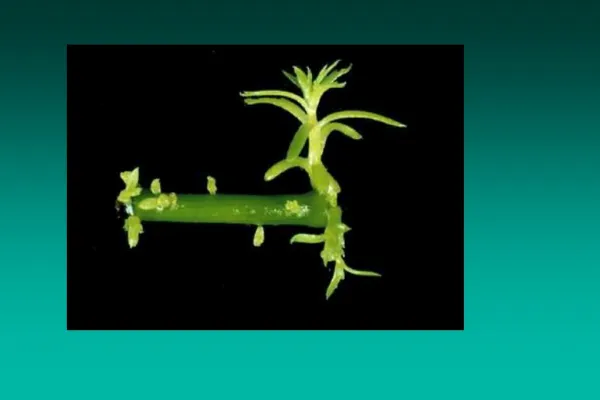

Somatic Embryogenesis
E N D
Presentation Transcript
Somatic Embryogenesis • Parthenocarpy • Apomixis • In vitro somatic embryogenesis
Somatic Embryos • Bipolar • Not connected to explant or callus cells by vascular tissue • In most woody plants, tissue must be juvenile or reproductive
Induction • Auxins required for induction • Proembryogenic masses form • 2,4-D most used • NAA, dicamba also used
Development • Auxin must be removed for embryo development • Continued use of auxin inhibits embryogenesis • Stages are similar to those of zygotic embryogenesis • Globular • Heart • Torpedo • Cotyledonary • Germination (conversion)
Maturation • Require complete maturation with apical meristem, radical, and cotyledons • Often obtain repetitive embryony • Storage protein production necessary • Often require ABA for complete maturation • ABA often required for normal embryo morphology • Fasciation • Precocious germination
Germination • May only obtain 3-5% germination • Sucrose (10%), mannitol (4%) may be required • Drying (desiccation) • ABA levels decrease • Woody plants • Final moisture content 10-40% • Chilling • Decreases ABA levels • Woody plants
Factors that Influence SE • Genotype • Growth regulators • Carbon source • Nitrogen
Micropropagation “… the art and science of multiplying plants in vitro.”
Rapid clonal in vitro propagation of plants: • from cells, tissues or organs • cultured aseptically on defined media • contained in culture vessels • maintained under controlled conditions of light and temperature
Toward Commercial Micropropagation 1950s Morel & Martin 1952 Meristem-tip culture for disease elimination
Commercialization of Micropropagation 1970s & 1980s Murashige 1974 Broad commercial application
Clone Genetically identical assemblage of individuals propagated entirely by vegetative means from a single plant.
Conventional Propagation • Cuttings • Budding, grafting • Layering
Conventional Propagation Advantages • Equipment costs minimal • Little experience or technical expertise needed • Inexpensive • Specialized techniques for growth control (e.g. grafting onto dwarfing rootstocks)
Micropropagation Advantages • From one to many propagules rapidly • Multiplication in controlled lab conditions • Continuous propagation year round • Potential for disease-free propagules • Inexpensive per plant once established
Micropropagation Advantages • Precise crop production scheduling • Reduce stock plant space • Long-term germplasm storage • Production of difficult-to-propagate species
Micropropagation Disadvantages • Specialized equipment/facilities required • More technical expertise required • Protocols not optimized for all species • Plants produced may not fit industry standards • Relatively expensive to set up?
Micropropagation Applications • Rapid increase of stock of new varieties • Elimination of diseases • Cloning of plant types not easily propagated by conventional methods (few offshoots/ sprouts/ seeds; date palms, ferns, nandinas) • Propagules have enhanced growth features (multibranched character; Ficus, Syngonium)
Explant • Cell, tissue or organ of a plant that is used to start in vitro cultures • Many different explants can be used for micropropagation, but axillary buds and meristems are most commonly used
Choice of explant • Desirable properties of an explant: • Easily sterilizable • Juvenile • Responsive to culture • Importance of stock plants • Shoot tips • Axillary buds • Seeds • Hypocotyl (from germinated seed) • Leaves
Methods of micropropagation >95% of all micropropagation Genetically stable Simple and straightforward Efficient but prone to genetic instability Little used, but potentially phenomenally efficient • Axillary branching • Adventitious shoot formation • Somatic embryogenesis
Axillary shoot proliferation Growth of axillary buds stimulated by cytokinin treatment; shoots arise mostly from pre-existing meristems
Shoot Culture Method Overview • Clonal in vitro propagation by repeated enhanced • formation of axillary shoots from shoot-tips or • lateral meristems cultured on media • supplemented with plant growth regulators, • usually cytokinins. • Shoots produced are either rooted first in vitro • or rooted and acclimatized ex vitro
ADVANTAGES • Reliable rates and consistency of shoot multiplication • 3 -8 fold multiplication rate per month • Pre-existing meristems are least susceptible to • genetic changes
mericloning A propagation method using shoot tips in culture to proliferate multiple buds, which can then be separated, rooted and planted out
First commercially used with orchids - conventional propagation rate of 1 per year. • Through protocorms, 1,000,000 per year. Corm (Swollen stem) Chop into pieces Maturation
Axillary shoot production • Selection of plant material • Establish aseptic culture • Multiplication • Shoot elongation • Root induction / formation • Acclimatization
Selection of plant material • Part of plant • Genotype • Physiological condition • Season • Position on plant • Size of explant
Physiological state - of stock plant • Vegetative / Floral • Juvenile / Mature • Dormant / Active • Carbohydrates • Nutrients • Hormones